Your Baby Doesn't Need Expensive Toys to Develop Well — Here's What They Need Instead
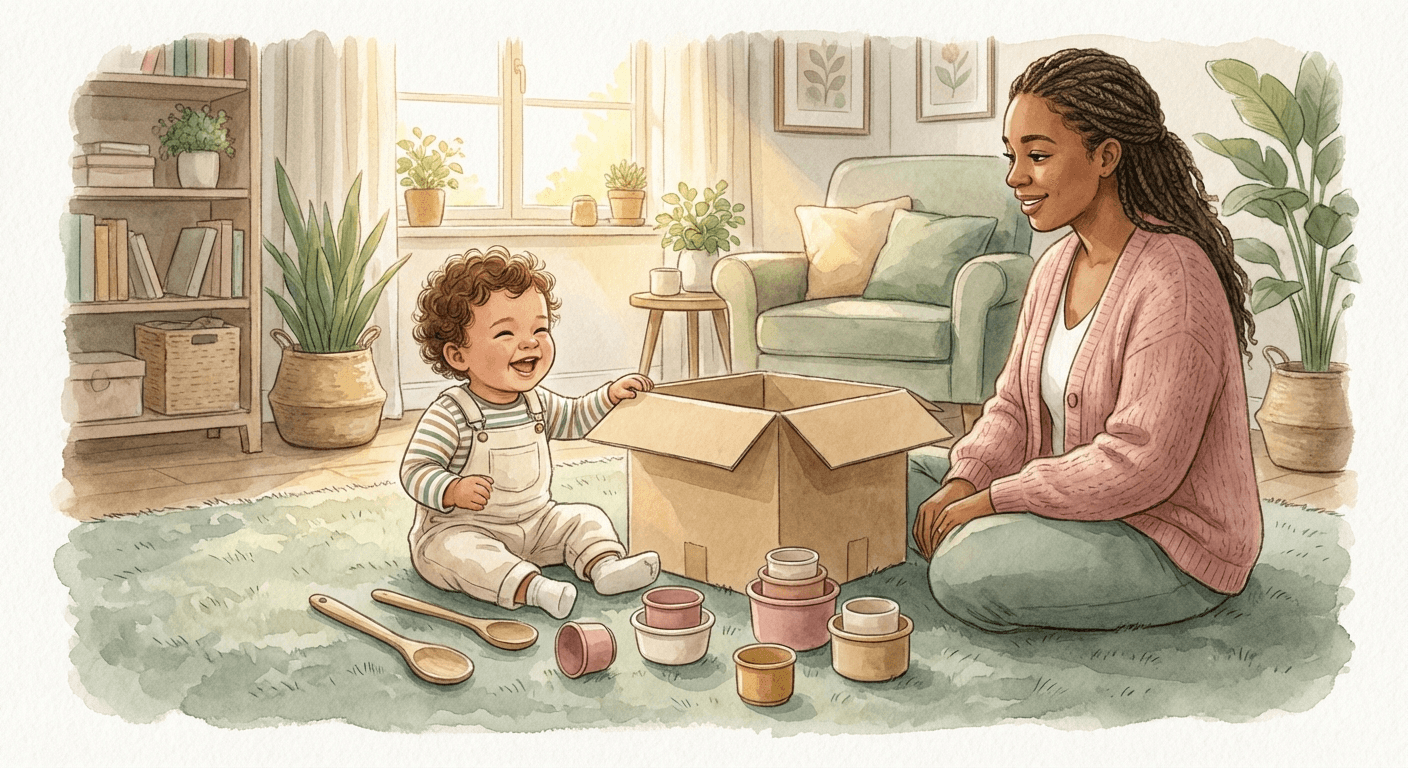
I Spent $200 on a "Brain-Building" Toy. My Baby Preferred the Box.
I'll never forget the day it arrived — a beautifully engineered activity centre that promised to stimulate cognitive development, fine motor skills, and early problem-solving. Lights. Sounds. Textures mapped to developmental milestones.
My baby looked at it for forty-five seconds. Then she crawled over to the cardboard box it came in, climbed inside, and played there for twenty minutes.
At the time, I laughed. But now that I've read the actual research on how babies' brains develop? That moment makes perfect sense. Science is remarkably clear: the most expensive toy in the room is almost never the most developmentally valuable one.
And honestly? That's one of the most liberating things I've learned as a parent.
The Baby Toy Industry Doesn't Want You to Know This
Let's start with the numbers, because they're staggering.
The global baby and toddler toy market was valued at $24.5 billion in 2024 and is projected to reach $48 billion by 2034. Over 80% of US parents actively buy toys aimed at enhancing motor and cognitive skills.
That's a lot of money flowing toward products that promise to make our babies smarter. And the marketing taps directly into something every parent feels: the fear that we're not doing enough.
"Brain-boosting." "Developmentally optimised." "Designed by child development experts." These phrases are designed to make you feel like your baby needs this specific $89 sensory cube to reach their potential.
But here's what the research actually says: your baby's brain doesn't develop through products. It develops through relationships, exploration, and play — most of which costs nothing at all.
What the Science Actually Says About Toys and Brain Development
Less Is Literally More
In 2018, researchers at the University of Toledo published a study that should be required reading for every parent navigating a toy-filled playroom. Dr. Carly Dauch and her colleagues observed 36 toddlers (aged 18-30 months) playing in two different environments: one with four toys, and one with sixteen.
The results were striking. When toddlers had fewer toys, they played with each one for twice as long and in significantly more creative ways. They explored more deeply, problem-solved more actively, and showed higher quality engagement overall.
The sixteen-toy environment? The children flitted between objects, spending less time with each and engaging in shallower play. More options led to more distraction — not more learning.
When I read this study, I looked at our overflowing toy bins and felt relief. The solution wasn't to buy better toys. It was to offer fewer of them.
The "90% Kid, 10% Toy" Rule
Developmental psychologist Kathy Hirsh-Pasek from Temple University has spent decades studying how children actually learn. Her research, often conducted with her colleague Roberta Golinkoff, has produced one of my favourite rules of thumb for choosing toys:
"The best toys are 90% the kid, 10% the toy. If it's 90% the toy and 10% the kid — that's a problem."
In practice? A wooden block is a 90% kid toy — a car, a phone, a building, food for a teddy bear. The possibilities are limitless because the child's imagination drives the play. An electronic tablet that flashes and makes sounds when pressed? That's 90% toy. The device does the interesting stuff. The child just watches.
A decade-long study at Eastern Connecticut State University confirmed this. After observing children with over 100 toy types, researchers found that simple, open-ended, non-realistic toys consistently inspired the highest quality play — more creativity, peer interaction, language use, and sustained engagement.
The fanciest toy in the room lost to a pile of blocks. Every time.
Electronic Toys Actually Reduce Learning
This is the one that really got me. In 2016, researcher Anna Sosa published a study in JAMA Pediatrics — one of the most prestigious medical journals in the world — that looked at what happens when parents and babies play with electronic toys versus traditional ones.
She observed 26 parent-infant pairs (babies aged 10-16 months) playing with electronic toys, traditional toys, and books. The findings were unambiguous:
- Fewer words spoken by parents during electronic toy play
- Fewer conversational turns between parent and child
- Fewer parental responses to the child's vocalisations
- Less content-specific language (colours, shapes, animal names)
- Fewer child vocalisations compared to book play
When the toy does the talking, the parent stops. And it's the parent's talking that matters most.
The AAP's 2019 clinical report — "Selecting Appropriate Toys for Young Children in the Digital Era" — drew the same conclusion. Electronic toys marketed as "educational" primarily aid memorisation rather than developing what actually matters: emotional regulation, creativity, flexible thinking, and problem-solving. Their recommendation? Go old-school.
So What DOES Build Your Baby's Brain?
If it's not expensive toys, then what? The answer is deceptively simple.
1. You. Seriously, Just You.
The Harvard Center on the Developing Child has identified "serve and return" interactions as the single most important ingredient in early brain development. Here's how it works:
Your baby "serves" — a babble, a gesture, a pointed finger, a cry. You "return" — with eye contact, words, a smile, engagement. This back-and-forth, repeated thousands of times a day, is what literally wires your baby's brain.
Every time you respond to your baby's coo with a "Oh, really? Tell me more!" you're strengthening neural pathways. Every time you follow their gaze to a bird outside and say "Look, a bird! It's flying!" you're building language architecture. Every time you comfort a cry, you're teaching their stress-response system to regulate.
No toy can replicate this. A toy can beep and flash. But it cannot notice your baby just pointed at the dog and respond with warmth, words, and shared attention. That's uniquely human — and irreplaceable.
2. Household Objects (Yes, Really)
UNICEF and Zero to Three both emphasise that common household items are genuinely excellent developmental tools. This isn't a consolation prize — it's what the research supports.
Here's why everyday objects work so well:
- Wooden spoons and pots — cause and effect, rhythm, sensory input, grip strength
- Cardboard boxes — imaginative play, spatial awareness, gross motor skills
- Measuring cups and containers — nesting, stacking, size comparison, early maths concepts
- Scarves and fabric — peek-a-boo, texture exploration, object permanence
- Safe kitchen items — sorting, categorising, fine motor practice
- Water and cups at bath time — pouring, volume, cause and effect
These aren't second-rate substitutes. A toddler nesting measuring cups is doing real cognitive work — figuring out size relationships, testing hypotheses, practising coordination. Brain development in real time, for free.
3. Open-Ended, Simple Toys
When you do buy toys, the research points clearly toward a few types that consistently support development:
Blocks — possibly the single most studied and validated toy in developmental science. Building, stacking, knocking down, sorting, pretending. Blocks grow with your child from 6 months through to school age.
Balls — rolling, throwing, chasing. Builds gross motor skills, cause and effect understanding, turn-taking, and social play.
Art supplies — crayons, washable paint, play dough. Strengthens fine motor skills, self-expression, and creativity.
Simple dolls and stuffed animals — enables pretend play, nurturing behaviours, language practice, and emotional processing.
Books — the Sosa study found books generated the richest language interactions of any "toy" category. Read early. Read often. Let them chew the pages.
Notice the pattern? Simple. Open-ended. Requires the child to bring the imagination. And naturally invites an adult to join in.
4. The Great Outdoors
Nature provides textures, sounds, temperatures, and visual complexity that no toy designer can replicate. Research shows outdoor play enhances attention and memory, builds motor skills, and even lowers cortisol levels. A walk where your baby touches grass, watches leaves, and hears birds is a multi-sensory brain workout — and the toys evolution designed your baby's brain for.
5. Routine Moments You're Already Having
Here's the part that gets me: you're probably already doing most of this.
Bath time? Sensory exploration and language building. Mealtime? Fine motor skills and independence. Getting dressed? Body awareness and turn-taking. Walking to the shops? A narrated adventure through new sights and sounds.
The research from Zero to Three is clear: daily routines are some of the richest learning opportunities in a young child's life. You don't need to add special activities — just be present during the ones you're already doing.
The Myth of the Optimised Childhood
We live in a culture that has convinced parents that every moment of childhood needs to be optimised. That there's a "right" toy for every milestone. That if you're not actively stimulating your baby's brain with purpose-built products, you're falling behind.
This is marketing. It is not science.
The science says something gentler: babies are born ready to learn from the world around them. They need loving humans who respond to them, a safe environment to explore, and simple objects to wonder about.
As the AAP put it in their 2019 report: "A toy's most important attribute is its capacity to bring the parent or caregiver and the child together in playful interactions that are warm and full of rich language."
That attribute doesn't come with a price tag.
A Practical Guide: What to Actually Do
Here's your practical game plan.
Rotate, don't accumulate. Keep 4-5 toys accessible at a time. Store the rest. Swap them every week or two. Your child will play more deeply with fewer options.
Choose open-ended over electronic. When you do buy, pick toys your child can use in multiple ways. Blocks over battery-operated anything.
Raid your kitchen. Wooden spoons, measuring cups, containers with lids, empty boxes. These are legitimate developmental tools. Give yourself permission to use them without guilt.
Get outside daily. Even 15 minutes of outdoor exploration provides rich sensory input that supports brain development.
Talk, narrate, respond. The single most powerful thing you can do for your baby's brain costs nothing: talk to them. Describe what you see. Respond when they babble. Follow their curiosity.
Stop comparing. That Instagram parent with the curated Montessori shelf? Their baby also prefers the box.
Key Takeaways
- The baby toy industry is worth billions, but research consistently shows expensive toys aren't necessary for healthy brain development
- A University of Toledo study found toddlers play twice as long and more creatively when given 4 toys instead of 16 — less really is more
- Electronic toys actually reduce parent-child conversation, which is the real engine of language development (Sosa, 2016, JAMA Pediatrics)
- The AAP, Harvard, Zero to Three, and UNICEF all agree: responsive interaction with caregivers matters far more than any product
- Simple household items, open-ended toys like blocks, and outdoor play provide everything a developing brain needs
- The most powerful brain-building tool is free — it's a loving, responsive parent who talks, plays, and pays attention
You Are the Best Toy in the Room
I want to leave you with this, because I think it's the thing most parents need to hear.
If you're lying on the floor making silly faces at your baby — you're doing it. If you're narrating your grocery trip like a nature documentary — you're doing it. If you're reading the same board book for the fifteenth time today because they keep handing it back to you — you are absolutely, unequivocally doing it.
Your baby's brain is making a million new neural connections every second. And the research is overwhelming: the connections that matter most are built through the warm, responsive, playful moments you share together. Not through a product. Through you.
So the next time you see a $150 "cognitive development system" and feel that familiar pang of parental guilt — remember the box. Remember the wooden spoon. Remember the peek-a-boo game that made your baby laugh so hard they got hiccups.
That was brain development at its finest. And it was free.
Stay in the loop
Weekly tips backed by science, delivered with love.
You might also like
Boys' Brains vs. Girls' Brains: What Neuroscience Actually Tells Us
Are boys really "wired" for trucks and girls for dolls? The science of sex differences in baby brains is way more nuance…
Does Classical Music Make Babies Smarter? The Mozart Effect, Debunked
You've heard that playing Mozart will boost your baby's brainpower. The truth? The original study wasn't even about babi…