Does Classical Music Make Babies Smarter? The Mozart Effect, Debunked
The CD That Started Everything
When I was pregnant, someone gave me a "Baby Mozart" CD at my baby shower. The card said something like, "For raising a little genius!" I smiled, said thank you, and honestly? I played it. A lot. During nursing sessions, during tummy time, during those desperate 4am stretches when I would have tried literally anything.
I thought I was giving my baby a head start. Turns out, I was mostly giving myself some nice background music.
The idea that classical music — specifically Mozart — makes babies smarter is one of the most persistent myths in parenting. It's been around for over 30 years, it launched a billion-dollar industry, and it even influenced government policy. And almost none of it is based on what the science actually found.
Let me walk you through what really happened.
The Study That Started the Myth (It Wasn't About Babies)
In 1993, psychologist Frances Rauscher and her colleagues at the University of California, Irvine, published a short paper in the journal Nature. They had 36 college students listen to 10 minutes of Mozart's Sonata for Two Pianos in D Major, then take a spatial reasoning test — the kind where you mentally fold and cut paper shapes.
The students who listened to Mozart scored slightly higher than those who sat in silence or listened to a relaxation tape. The boost was roughly 8-9 IQ points on that specific task.
Here's what the study actually showed:
- The participants were college students, not babies
- The improvement was only in spatial reasoning — one narrow cognitive skill
- The effect lasted 10-15 minutes, then vanished completely
- It had nothing to do with general intelligence
That's it. That was the entire finding. A temporary, task-specific bump in spatial reasoning among adults.
But that's not the story the world heard.
How a Modest Finding Became a Parenting Obsession
The media took that small study and ran with it. Headlines screamed that Mozart makes you smarter. The nuance — college students, one task, 15 minutes — evaporated overnight. And then it got really wild.
In 1998, Georgia Governor Zell Miller proposed spending $105,000 in state funds to give every newborn in the state a classical music CD. He even played Beethoven's "Ode to Joy" for the state legislature to make his case. (Sony ended up donating the CDs for free.) That same year, the Baby Einstein Company released the "Baby Mozart" video, marketed directly at parents who wanted to give their infants a cognitive edge.
Suddenly, playing Mozart for your baby wasn't just a nice thing to do — it felt like a parental obligation. If you weren't doing it, were you failing your child?
The answer, according to the actual science, is a definitive no.
What the Research Really Shows
Once the Mozart effect went viral, scientists did what scientists do — they tried to replicate it. And here's what they found:
The effect mostly disappeared
In 1999, psychologist Christopher Chabris published a meta-analysis in Nature that examined 16 studies. He found the actual effect was about 1.4 IQ points — barely measurable, and nowhere near the 8-9 points from the original study. He titled his paper "Prelude or Requiem for the 'Mozart Effect'?" (Spoiler: it was a requiem.)
It's not about Mozart — it's about mood
In 2001, researchers Thompson, Schellenberg, and Husain tested whether the effect was unique to Mozart or just the result of listening to something you enjoy. They had people listen to Mozart (upbeat and pleasant) versus Albinoni (slow and sad). When they controlled for arousal and mood, the Mozart effect completely disappeared.
Their conclusion? Any music you enjoy gives you the same temporary boost. It's not Mozart's genius rubbing off on you — it's that being in a good mood temporarily helps you think more clearly. You'd get the same effect from your favourite pop song or a really good podcast.
The final nail in the coffin
In 2010, researchers Pietschnig, Voracek, and Formann published the most comprehensive meta-analysis to date in the journal Intelligence, examining nearly 40 studies with over 3,000 participants. Their findings:
- Compared to silence, Mozart gave a small benefit (d = 0.37)
- Compared to any other music, the benefit was negligible (d = 0.15)
- Studies from Rauscher's own lab showed significantly higher effects than anyone else's — suggesting possible publication bias
They literally titled their paper "Mozart Effect–Shmozart Effect." Scientists don't get sarcastic often, but when they do, you know the myth is truly dead.
Even the original researcher says it's a myth
Frances Rauscher herself — the scientist whose work started all of this — has publicly stated that the popular interpretation of her research is wrong. Her study never claimed that passive listening improves intelligence in babies. She's been trying to correct the record for decades, but the myth has been remarkably resistant to facts.
So Does Music Matter at All for Baby Brains?
Here's where the story gets genuinely exciting. Because while passively playing Mozart doesn't make babies smarter, actively engaging with music absolutely does help brain development. The key word is active.
The University of Washington study (2016)
Researchers Christina Zhao and Patricia Kuhl at the University of Washington's Institute for Learning & Brain Sciences studied 9-month-old babies who participated in 12 play sessions involving rhythmic music activities over one month.
Using brain imaging (MEG), they found that the babies in the music group showed enhanced brain processing of both music and speech sounds. The musical play sharpened responses in the auditory cortex and the prefrontal cortex — the area responsible for detecting patterns, which is crucial for language development.
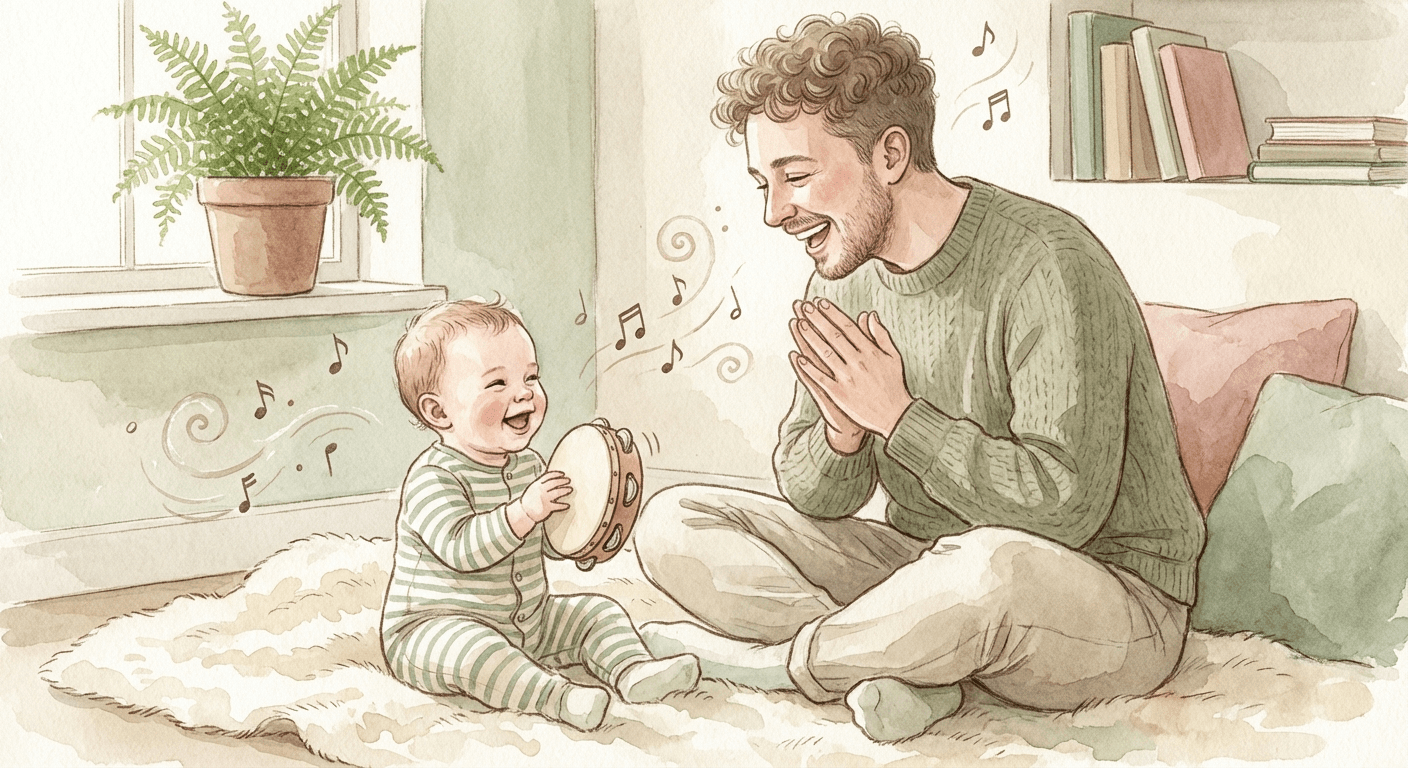
The key: these weren't babies passively listening to a speaker. They were actively engaged — bouncing, clapping, experiencing rhythm with their caregivers.
The McMaster University study (2012)
Researcher Laurel Trainor and her team studied two groups of babies and parents over six months, starting when the infants were about 6 months old. One group took interactive music classes — singing lullabies, playing percussion, learning songs with actions together. The other group had play sessions with Baby Einstein music playing in the background.
The results were striking:
- Babies in the interactive music group developed earlier sensitivity to musical pitch
- They showed better communication skills — more pointing, more gesturing
- They smiled more, were easier to soothe, and handled new situations better
- Their brains showed larger responses to musical tones
The passive listening group? None of these benefits.
This is the study I wish every parent would read. Because it tells us something really important: it's not the music that matters. It's the interaction.
Why Singing to Your Baby Is Better Than Any Playlist
Here's the beautiful irony: the most powerful musical activity for your baby's brain isn't a curated Spotify playlist of classical concertos. It's you, singing "Twinkle, Twinkle, Little Star" for the fourteenth time today.
Research shows that singing to babies:
- Calms them twice as long as speaking to them (studies by Sandra Trehub and colleagues)
- Triggers oxytocin release in both parent and baby, strengthening your bond
- Supports language development through rhythmic patterns, repetition, and exaggerated speech cues
- Engages them more deeply than recorded music — babies prefer live singing to recordings
When I learned that my off-key rendition of "You Are My Sunshine" was actually building neural pathways, I felt a genuine wave of relief. You don't need to be a good singer. You don't need to play an instrument. You don't need to buy a single product.
You just need to be present and make music together.
What Actually Helps: 6 Evidence-Based Ways to Use Music With Your Baby
Now that we've cleared away the myth, here's what the science actually supports:
1. Sing to your baby — any song, any skill level
Your voice is your baby's favourite sound in the world. Lullabies, nursery rhymes, whatever's stuck in your head from the radio — it all counts. The rhythm and repetition in songs help your baby's brain learn to detect patterns in language.
2. Make music interactive
Clap together. Tap on pots and pans. Shake a rattle to a beat. Bang a wooden spoon on a container. The more your baby is an active participant rather than a passive listener, the more their brain benefits.
3. Dance and move together
Hold your baby and sway to music. Let your toddler stomp and spin. Movement combined with music activates motor areas of the brain alongside auditory processing, creating richer neural connections.
4. Use music for routines
A clean-up song. A bath-time song. A bedtime lullaby. Pairing music with daily routines helps your baby predict what's coming next, which builds their sense of security and supports executive function development.
5. Play any music you genuinely enjoy
Remember — the research shows it's enjoyment and engagement that matter, not the genre. If you love jazz, play jazz. If you love K-pop, play K-pop. Your enthusiasm is contagious, and a happy, engaged parent makes for a happy, engaged baby.
6. Don't stress about "optimizing" it
You don't need a music curriculum for your 6-month-old. You don't need special apps or programs. The everyday musical moments — humming while you cook, singing in the car, playing peekaboo with a rhythm — are already doing the work.
Key Takeaways
- The "Mozart effect" was based on a 1993 study of college students, not babies — the temporary boost in spatial reasoning lasted only 10-15 minutes
- Multiple meta-analyses have confirmed that passively listening to classical music does not improve infant intelligence or cognitive development
- The small cognitive boost from music is explained by mood and arousal — any enjoyable music produces the same effect
- Active music-making (singing, clapping, dancing together) genuinely benefits baby brain development, including language processing and social skills
- Research from the University of Washington and McMaster University shows interactive musical experiences enhance brain responses to both music and speech
- The best musical activity for your baby's brain is free: singing to them, with them, in your own imperfect voice
You Can Put the Mozart CD Down Now
Look, I'm not saying don't play classical music for your baby. Mozart is beautiful. Beethoven is extraordinary. If you enjoy it, play it. Music of any kind creates a rich auditory environment, and shared enjoyment between you and your baby is never wasted.
But if you've been playing "Eine Kleine Nachtmusik" on repeat because you thought it was building IQ points? You can exhale. That pressure was never based on real science.
The real magic isn't in what you play — it's in how you play together. Every time you sing a silly song, every time you clap along to music, every time you dance around the kitchen with your baby on your hip, you're doing more for their brain development than any playlist ever could.
The scientist who accidentally started this whole myth has spent decades trying to tell parents: it was never about the music. It was always about the connection.
So tonight, when you're doing the bedtime routine, sing whatever song comes to mind. It doesn't matter if it's Mozart or "Baby Shark." What matters is that it's you, and you're there, and your baby's brain is soaking up every moment of it.
That's not a myth. That's neuroscience.
Stay in the loop
Weekly tips backed by science, delivered with love.
You might also like
Your Baby Doesn't Need Expensive Toys to Develop Well — Here's What They Need Instead
The baby toy industry is worth billions — but research shows the best brain-building tools are free. Here's what science…
Boys' Brains vs. Girls' Brains: What Neuroscience Actually Tells Us
Are boys really "wired" for trucks and girls for dolls? The science of sex differences in baby brains is way more nuance…