What Happens in Your Toddler's Brain During a Tantrum
The Tantrum That Changed How I See Tantrums
It happened in the cereal aisle. My toddler wanted the box with the cartoon tiger on it. I said no. And then — like a switch had been flipped — she was on the floor, screaming, kicking, completely gone.
I remember standing there, strangers staring, thinking: What is happening right now? Where did my sweet kid go?
Here's what I wish I'd known in that moment: my daughter wasn't being bad. Her brain was being overwhelmed. What looked like defiance was actually a neurological event — her developing brain hitting a wall it wasn't yet built to handle.
Once I understood what's actually happening inside a toddler's brain during a tantrum, everything changed. Not the tantrums themselves (sorry, those still happen), but how I felt about them — and how I responded. So let's get into the science, because it's genuinely fascinating. And honestly? It's really reassuring.
The Two-Story Brain: A Simple Way to Understand It
Dr. Dan Siegel, a clinical professor of psychiatry at UCLA, uses a brilliant analogy that I think about almost daily. He describes the brain as a two-story house:
The downstairs brain includes the brain stem and the limbic system (which houses a tiny almond-shaped structure called the amygdala). This part handles the basics — breathing, heart rate, strong emotions like fear and anger, and those instant survival instincts: fight, flight, or freeze. The downstairs brain is fully online from birth. It's fast, reactive, and powerful.
The upstairs brain is the cerebral cortex, especially the prefrontal cortex — the part right behind your forehead. This is the thinking brain. It handles reasoning, impulse control, empathy, emotional regulation, and decision-making. It's the part that would say, "I'm frustrated about the cereal, but I can handle this."
Here's the catch: your toddler's upstairs brain is basically a construction site. The prefrontal cortex begins significant development around age 3 and doesn't fully mature until the mid-twenties. That's not a typo. The mid-twenties.
So when your toddler is in the grip of a tantrum, they're trying to manage a five-alarm emotional fire with a fire station that hasn't been built yet.
What's Actually Happening During a Meltdown
Let's zoom in on the neuroscience. When your toddler encounters something overwhelming — being told no, a broken cracker, the wrong color cup (been there) — here's the chain reaction:
Step 1: The Amygdala Sounds the Alarm
The amygdala is your toddler's emotional alarm system, constantly scanning for threats. To a toddler's brain, "I can't have the thing I want" registers as a genuine threat — the amygdala doesn't distinguish between a lion and a denied cookie.
Once it fires, it triggers the release of stress hormones — cortisol and adrenaline. Heart rate increases. Muscles tense. Breathing gets faster. The body is preparing for battle.
Step 2: The Prefrontal Cortex Goes Offline
In an adult brain, the prefrontal cortex would step in now — modulate the alarm, bring the emotional temperature down, choose a reasonable response. But in your toddler? That connection barely exists yet. The neural pathways between the amygdala and the prefrontal cortex are still being wired and myelinated (coated with insulation that makes signals travel efficiently). At age two, these connections are sparse and unreliable.
Dr. Siegel calls this "flipping the lid" — the thinking brain disconnects from the emotional brain, and the downstairs takes over completely.
Step 3: The Emotional Flood
With the prefrontal cortex offline and stress hormones surging, your toddler is now in full fight-or-flight mode. This isn't a choice. This isn't manipulation. This is their nervous system doing exactly what it's designed to do when it perceives a threat and has no higher-order thinking available to override it.
The screaming, the kicking, the throwing themselves on the floor — these are the body's way of discharging that massive wave of stress energy. Your toddler is literally overwhelmed by their own brain chemistry.
This is why saying "calm down" to a tantruming toddler doesn't work. You're asking the prefrontal cortex to do its job, but the prefrontal cortex has left the building.
This Is Completely Normal (And Incredibly Common)
If you're wondering whether your toddler tantrums too much — deep breath. The numbers are reassuring.
Research by pediatric neuroscientist Dr. Michael Potegal found that tantrums occur in 87% of 18- to 24-month-olds and peak at 91% of 30- to 36-month-olds. That means if your toddler is having tantrums, they're in the overwhelming majority. By 42 to 48 months, the prevalence drops to 59% as the prefrontal cortex gains more capacity.
The average toddler has roughly one tantrum per day, and most last about 3 minutes — though I know those 3 minutes can feel like 3 hours. The most common duration is actually only 30 seconds to a minute. They just feel eternal when you're in the middle of one.
Here's another interesting finding: tantrum frequency is inversely related to vocabulary. Toddlers with larger vocabularies at age two tend to have fewer tantrums by age three. This makes complete sense — so much of tantrum frustration comes from the gap between what a toddler understands and feels, and what they can actually express with words.
The Communication Gap: Fuel for the Fire
Imagine you understand everything happening around you — you have wants, opinions, and strong feelings — but you can only express about 50 words, and half the time nobody understands you.
That's your toddler's daily reality. Researchers call this the "communication gap" — the disconnect between what toddlers understand and what they can say. By 18 months, most toddlers understand roughly 200 words but can only say about 20. That's a recipe for frustration.
When your toddler can't tell you they wanted the banana whole, not cut, and their brain can't regulate the resulting disappointment — boom. Tantrum. I remember the phase when my daughter would dissolve because I peeled her banana "wrong." Now I understand she had a clear expectation, couldn't articulate it, and had zero neurological capacity to manage the disappointment. Through the lens of brain development, it makes perfect sense.
Two Types of Tantrums (And Why It Matters)
Dr. Siegel identifies two types. A "downstairs" tantrum is a true meltdown — the child is genuinely overwhelmed, the prefrontal cortex is offline, and they have no conscious control. Signs: glazed eyes, inability to hear you, intense physical distress. Your job here is to be their external calm until their thinking brain comes back online.
An "upstairs" tantrum is more intentional — the child is upset but still has some access to their thinking brain. They might check if you're watching or negotiate through tears. Here, you calmly hold the boundary while acknowledging the feeling.
In real life, it's not always easy to tell the difference. When in doubt, lead with empathy. You can always hold a boundary and be compassionate at the same time.
Co-Regulation: Your Secret Superpower
Here's the most empowering part of the science: because your toddler's brain can't regulate itself yet, you get to be their regulator. Researchers call this co-regulation, and it's one of the most important concepts in early brain development.
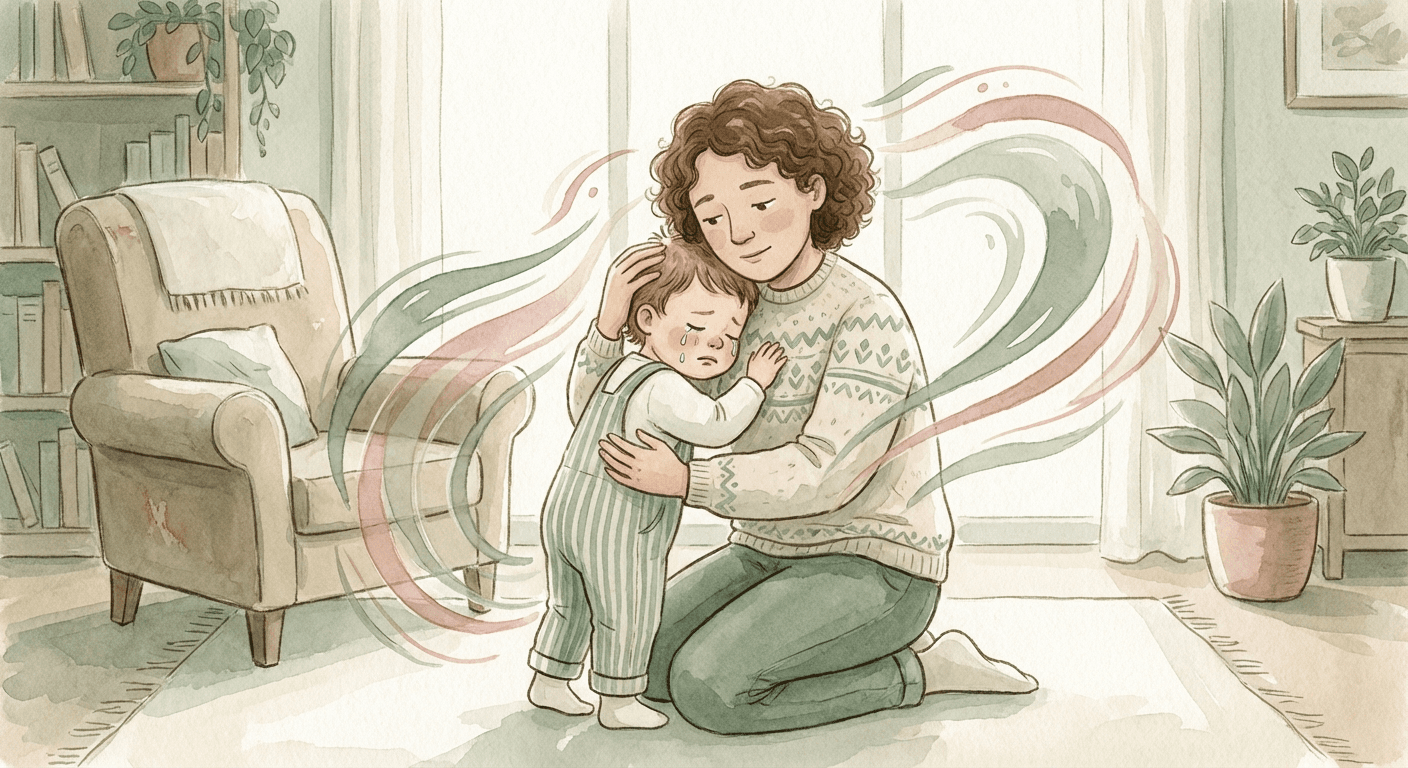
When you stay calm during your toddler's storm, your regulated nervous system helps bring their nervous system down. Your steady breathing, warm tone, and calm presence communicate safety to your toddler's amygdala. Cortisol levels start to drop.
Zero to Three emphasizes that co-regulation isn't just comforting — it's brain-building. Every time you help your toddler move through a big emotion, you're strengthening neural connections between their emotional brain and developing prefrontal cortex. Research highlighted by Harvard's Center on the Developing Child shows that toddlers whose parents consistently validate emotions develop stronger prefrontal cortex connectivity by age four. Your patience during tantrums is building architecture that will serve your child for life.
Conversely, consistently punitive responses can increase cortisol levels and slow the development of self-regulation. This doesn't mean you never set boundaries — it means you hold the line while being emotionally supportive.
What You Can Do: Science-Backed Strategies
Okay, you understand the brain science. Now what do you actually do when your toddler is melting down in Target? Here are evidence-based approaches:
1. Stay Calm (or Fake It)
Your calm is their calm. Take a deep breath. Lower your shoulders. Speak slowly and softly. Even if you're faking it, your body language sends safety signals to your toddler's brain.
2. Validate the Feeling, Hold the Boundary
"You're really mad that you can't have that toy. I get it. But we're not buying it today." Name the emotion. Research shows that labeling an emotion helps the brain begin to process it.
3. Get Low and Close
Kneel down to their level. If they'll let you, offer a hug or gentle touch. Physical closeness activates oxytocin, which directly counteracts cortisol. If they push you away, stay nearby.
4. Reduce Stimulation
Move to a quieter space if possible. An overwhelmed nervous system doesn't need bright lights, loud sounds, and an audience.
5. Build Their Vocabulary
Outside of tantrum moments, help your toddler build emotional vocabulary. Use feeling words throughout the day: "You look frustrated." "That made you happy!" The more words they have for feelings, the less often those feelings erupt as tantrums.
6. Create Predictable Routines
Predictability reduces the "threats" the amygdala detects. Transitions are tantrum triggers, so give advance warnings: "In five minutes, we're leaving the playground."
7. Don't Take It Personally
Your toddler is not giving you a hard time. They're having a hard time. Their brain is doing exactly what a developing brain does when it encounters more emotion than it can process.
Key Takeaways
- During a tantrum, the amygdala (emotional brain) overwhelms the prefrontal cortex (thinking brain), which won't fully mature until the mid-twenties — your toddler literally cannot "just stop"
- Tantrums occur in about 91% of toddlers aged 30-36 months — they are a normal, expected part of brain development, not bad behavior
- The communication gap between what toddlers understand and what they can express fuels frustration — building vocabulary helps reduce tantrums over time
- Co-regulation (your calm helping regulate their stress) is the single most powerful thing you can do during a tantrum — it actually builds the brain circuits for future self-regulation
- Consistently validating emotions while holding boundaries helps strengthen prefrontal cortex connections, enabling better emotional regulation by age four
- Stay calm, get low, name the feeling, reduce stimulation — and remember, this phase passes as the brain matures
This Phase Is Building Something Beautiful
I know tantrums are exhausting. I know the public ones make you want to crawl under the nearest display table. I know there are days when it feels like nothing you do makes a difference.
But here's what the science tells us: every tantrum is your toddler's brain practicing. It's learning what overwhelming emotions feel like. It's building the pathways it will eventually use to handle frustration, disappointment, and anger in mature, healthy ways. And every time you show up with patience and calm — even imperfect, shaky, just-barely-holding-it-together calm — you are actively wiring those pathways.
The Harvard Center on the Developing Child calls the responsive adult relationship the most critical ingredient in healthy brain architecture. Not flashcards. Not educational apps. You, showing up during the hard moments.
So the next time your toddler is on the supermarket floor, screaming about bananas, take a breath and remind yourself: this is brain development in action. It's messy and loud and inconvenient. But it's also temporary.
And you? You're not just surviving it. You're building a brain.
Stay in the loop
Weekly tips backed by science, delivered with love.
You might also like
Your Baby Doesn't Need Expensive Toys to Develop Well — Here's What They Need Instead
The baby toy industry is worth billions — but research shows the best brain-building tools are free. Here's what science…
Boys' Brains vs. Girls' Brains: What Neuroscience Actually Tells Us
Are boys really "wired" for trucks and girls for dolls? The science of sex differences in baby brains is way more nuance…