The Science of Baby Talk: Why That Silly Voice Actually Builds Brains
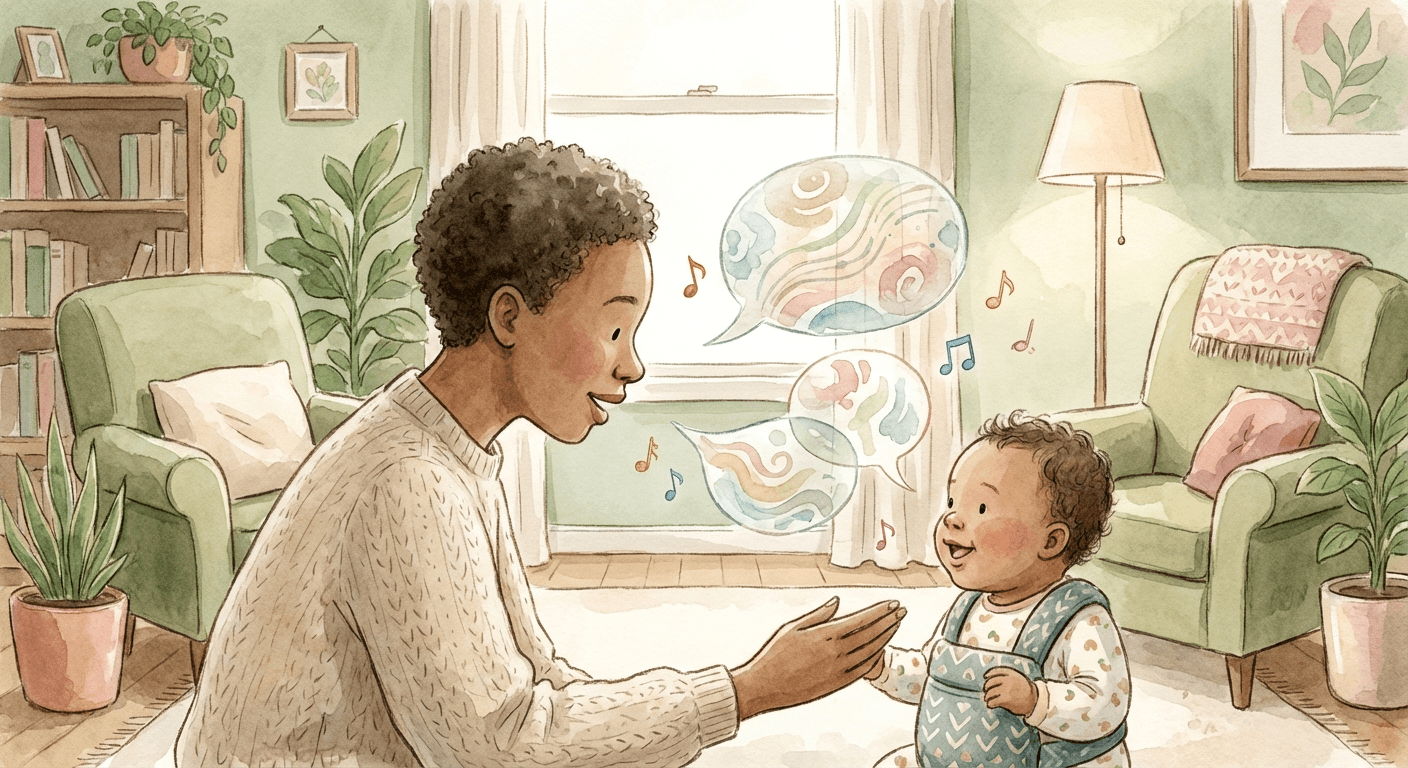
I Caught Myself Doing the Voice
I was at the grocery store, baby strapped to my chest, and I heard myself say — three octaves higher than my normal voice — "Oh, do you SEE the banaaaaaanas? Those are BA-NA-NAS!"
A teenager in the produce aisle looked at me like I'd lost my mind.
We've all been there, right? That moment where you catch yourself talking to your baby in this exaggerated, sing-songy, slightly ridiculous voice and wonder: Am I helping or am I just... weird?
Here's what I wish I'd known: that silly voice is one of the most powerful brain-building tools you have. It's not just a cute thing parents do — it's a cross-cultural phenomenon scientists have studied for decades, with results that blew my mind.
It Has a Name (And It's Not What You Think)
Scientists call that exaggerated speaking style "infant-directed speech" or, more recently, "parentese." And researchers are very specific about distinguishing parentese from "baby talk."
Here's the difference:
Baby talk is when you make up nonsense words — "Does the widdle baby want some num-nums?" It's cute, but it's not what the research is about.
Parentese uses real words and correct grammar, but delivered with a twist: higher pitch, slower tempo, elongated vowels, and exaggerated intonation. It's that musical, engaging quality in your voice when you say "Hiiiii, sweetheart! Look at the DOG-gie! What a biiiig doggie!"
Dr. Patricia Kuhl, co-director of the University of Washington's Institute for Learning & Brain Sciences (I-LABS), has spent decades studying parentese. She describes it as "a social hook for the baby brain" — its distinct pitch and rhythm naturally draw an infant's attention and invite them to respond.
And here's what's remarkable: parentese shows up in virtually every culture on earth. A 2022 meta-analysis examining 36 different languages found that the key features of infant-directed speech appear across the vast majority of the world's languages. Parents everywhere instinctively shift into this speech style when they look at a baby.
Your brain is wired to speak this way to infants. It's not silly. It's human.
What Happens Inside Your Baby's Brain When You Talk Like This
This is where it gets really cool.
When researchers put babies in neuroimaging studies and played recordings of parentese versus normal adult speech, they found something striking: parentese lights up more of the baby's brain.
Specifically, infant-directed speech activates increased neural responses in frontal brain regions — attention, social processing, and early language learning. Both 6-month-olds and 13-month-olds showed significantly greater brain activity with parentese versus regular adult conversation.
But here's what fascinated me most: when babies hear parentese, both the auditory cortex AND the motor areas for speech production light up. Your baby isn't passively hearing you — their brain is actively preparing to respond. Those little mouth movements and babbles? That's their brain rehearsing.
Dr. Kuhl's research showed that this dual activation — hearing plus motor planning — is what makes parentese so powerful. Your baby's brain treats parentese as an invitation to participate, not just listen.
The Vocabulary Explosion Connection
So parentese engages the brain differently. But does that engagement actually translate into real-world language skills?
The short answer: dramatically, yes.
A landmark study by Naja Ferjan Ramírez and colleagues at the University of Washington tracked families from when their babies were 6 months old. They gave families lightweight recorders that captured real at-home audio to measure how much parentese babies actually heard.
The findings: infants who received more one-on-one parentese had significantly larger vocabularies by age two. Follow-up research showed that children exposed to the highest levels of parentese in infancy had hundreds more words compared to those with the lowest exposure.
A 2020 study in PNAS took it further. When parents received coaching on parentese, their babies babbled more, engaged in more conversational back-and-forth, and produced more words by 14 and 18 months than babies whose parents weren't coached.
Let that sink in: something you're probably already doing naturally, without even thinking about it, is directly building your baby's vocabulary. And with a little awareness, you can do even more of it.
It's Actually Changing Their Brain Structure
Here's where the science gets genuinely mind-blowing.
It's not just about brain activity in the moment — talking to your baby is physically shaping the architecture of their brain.
A 2023 study published in the Journal of Neuroscience used MRI scans to examine the brains of babies and toddlers alongside recordings of how much speech they heard at home. The researchers found that the amount of adult speech babies heard was directly linked to myelin concentration in language-related brain pathways.
Myelin is the fatty insulation that coats nerve fibers, making brain signals faster and more efficient — think of it like the insulation around electrical wires. More myelin in language pathways means more efficient language processing.
What made this study especially fascinating was that the relationship between speech and myelin changed with age. For 6-month-olds, more speech exposure was linked to lower myelin — suggesting the brain was staying flexible and open to learning. By 30 months, more speech correlated with higher myelin, indicating the brain was locking in those language connections permanently.
And here's the kicker: conversational turns — those back-and-forth exchanges — uniquely predicted myelin density in critical language pathways, independent of total speech volume. The interactive quality of your communication matters even more than the sheer amount.
Your silly voice isn't just reaching your baby's ears. It's building the physical infrastructure of their brain.
The Magic of the Back-and-Forth
If there's one thing I want you to take away from the science, it's this: the conversation matters more than the monologue.
The Harvard Center on the Developing Child calls these back-and-forth exchanges "serve and return" interactions, and they describe them as essential to healthy brain development. The concept is simple:
- Your baby "serves" — a coo, a babble, a look, a gesture
- You "return" — you respond with eye contact, words, a smile
- And then you wait, giving them a chance to serve again
This isn't complicated. It doesn't require flashcards or apps or special training. It's the oldest form of human connection: two people paying attention to each other.
But the neuroscience behind it is profound. Each serve-and-return exchange strengthens neural connections in your baby's brain. When you use parentese to engage in these exchanges, you're combining two powerful brain-building forces at once — the attention-grabbing qualities of parentese with the connection-strengthening power of interactive communication.
I think about this during diaper changes — which used to feel like a chore. Now I know that when I'm making faces and narrating the whole experience ("Up go your leeeeegs! And here comes the clean diaper!"), I'm not being silly. I'm building neural architecture. That makes the fifteenth diaper change of the day feel a lot more meaningful.
"But What About Just Talking Normally?"
Fair question. If talking to your baby is good, why does the way you talk matter?
Here's why parentese specifically is so effective:
It grabs attention. Babies preferentially tune into parentese from birth. In the large-scale ManyBabies study, which tested infants across labs in seven countries, babies consistently preferred listening to parentese over adult-directed speech. They look longer, they engage more, and they stay focused. You can't learn from something you're not paying attention to.
It makes speech sounds clearer. The exaggerated vowels in parentese — the way you stretch out "baaaaaaby" — actually make the distinct sounds of your language more obvious to your baby's developing brain. A meta-analysis across dozens of studies confirmed that this vowel exaggeration, called "vowel hyperarticulation," helps babies distinguish the sounds that matter in their native language.
It slows things down. Adult conversation happens fast. Parentese's slower tempo and longer pauses give your baby's brain time to process, segment words, and begin understanding where one word ends and the next begins.
It's emotionally warm. The exaggerated intonation carries strong emotional signals — warmth, encouragement, delight — which strengthens your bond and primes your baby to learn from you. Babies learn language best from people they're attached to.
Overheard adult conversation isn't useless, but direct, interactive parentese is the premium fuel. It's the difference between hearing music in another room and having someone teach you to play.
How to Supercharge Your Parentese (7 Evidence-Based Tips)
The beautiful thing about parentese is that you're probably already doing it. But here's how to lean in and do more of it, based on what the research says matters most:
1. Make it one-on-one The studies are clear: **one-on-one parentese is where the magic happens.** Speech directed at your baby in a group setting doesn't have the same impact as when you're speaking directly to them, making eye contact, and engaging their attention. Even a few minutes of focused, one-on-one talking during a diaper change or feeding makes a difference.
2. Wait for the "return" After you say something, **pause and wait.** Give your baby time to coo, babble, kick their legs, or make a face back at you. Then respond to whatever they give you. These conversational turns are the gold standard for brain building. It's not about how much you talk — it's about the back-and-forth.
3. Narrate your day You don't need special activities. **Talk about what you're doing, seeing, and experiencing together.** "We're going UP the stairs! One, two, three stairs! Oh, and there's the kitty cat!" This gives your baby rich language exposure naturally woven into daily life.
4. Follow their gaze When your baby looks at something, **name it.** This is what researchers call "joint attention" — when you and your baby are focused on the same thing and you provide the word for it. It's one of the most effective ways babies connect words to objects.
5. Respond to all their sounds Every coo and babble is practice. **Treat their sounds as meaningful.** "Oh, you said 'ba ba ba!' Are you telling me about the blocks?" What matters is teaching them that their sounds get a response.
6. Use real words (with that wonderful voice) Instead of "look at the choo-choo," try **"Look at the TRAAAAAIN! It's going SO fast!"** You get the engaging delivery AND accurate vocabulary.
7. Don't stress about perfection You don't need to do this every second. **Even small increases have measurable effects.** The UW coaching study found that parents who simply became *more aware* of parentese saw real benefits in their children's language development. Any increase counts.
Key Takeaways
- "Parentese" — that instinctive high-pitched, sing-songy voice — is not the same as baby talk. It uses real words with exaggerated delivery, and it's found across virtually all cultures
- Parentese activates more of your baby's brain than normal speech, lighting up both hearing areas and speech-production areas simultaneously
- Babies exposed to more one-on-one parentese develop significantly larger vocabularies by age two
- Talking to your baby physically shapes their brain structure — a 2023 study linked speech exposure to myelin development in language pathways
- The back-and-forth conversation matters most — conversational turns between parent and baby are a stronger predictor of language development than total words heard
- You're probably already doing this naturally — even small increases in parentese use can measurably boost your baby's language skills
Keep Doing the Voice
So the next time you catch yourself in the grocery store, going full sing-song about the bananas — or narrating bath time like it's a nature documentary — don't feel silly.
Feel like a neuroscientist.
Because every time you lean in close and say "Hiiiii, beautiful! What do you SEE?" — and wait for that little coo in response — you're lighting up their frontal cortex, strengthening neural connections, and building the myelin pathways that will carry their language for a lifetime.
All with your voice. All with your attention. All with that wonderful, instinctive, slightly ridiculous way you talk to your baby.
That's not silly. That's science. And you've been doing it all along.
Stay in the loop
Weekly tips backed by science, delivered with love.
You might also like
Your Baby Doesn't Need Expensive Toys to Develop Well — Here's What They Need Instead
The baby toy industry is worth billions — but research shows the best brain-building tools are free. Here's what science…
Boys' Brains vs. Girls' Brains: What Neuroscience Actually Tells Us
Are boys really "wired" for trucks and girls for dolls? The science of sex differences in baby brains is way more nuance…