The Best Music for Baby Brain Development, According to Research
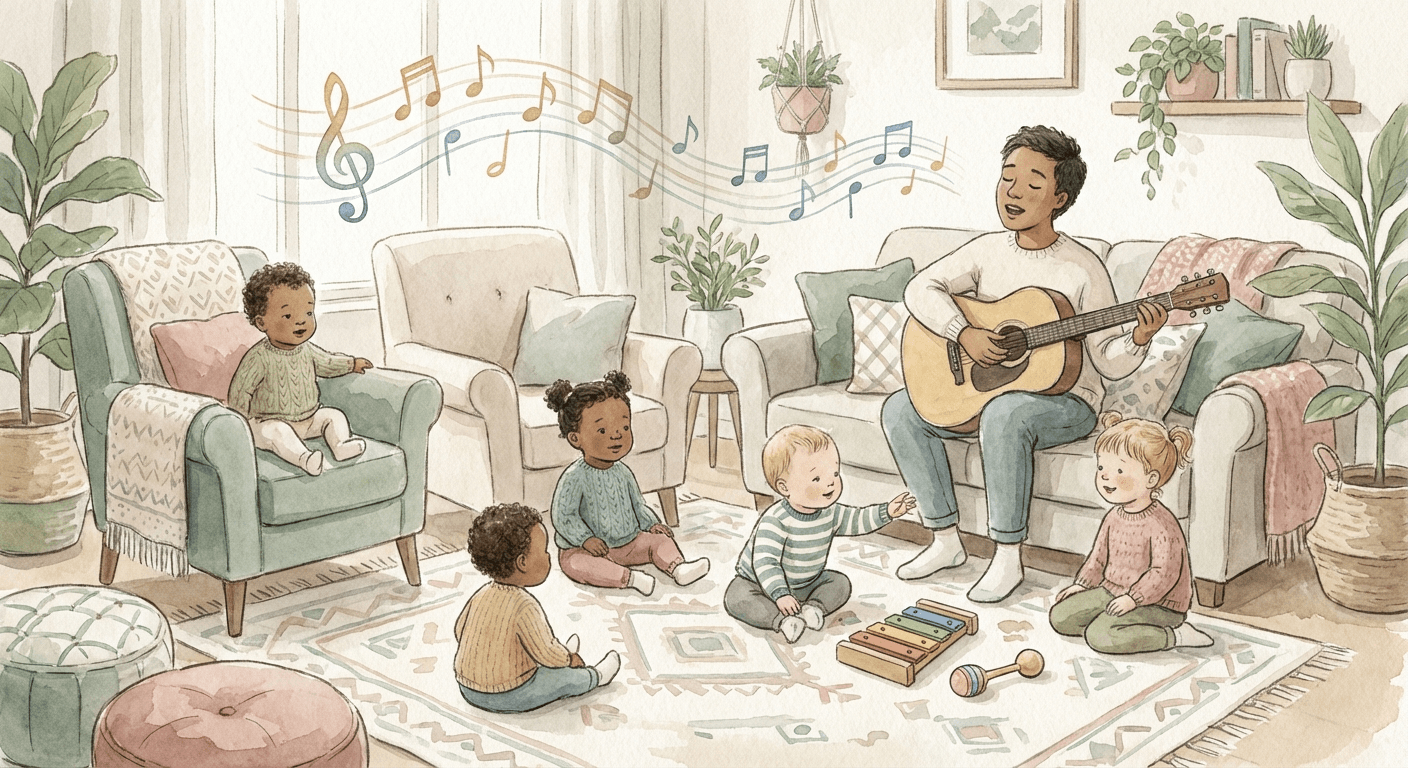
The Playlist That Changed My Mind
When I was pregnant, I did what a lot of us do: I Googled "best music for baby brain development" and dutifully downloaded a Mozart playlist. I played it through headphones pressed against my belly while feeling vaguely ridiculous. Because that's what you're supposed to do, right? Mozart makes babies smarter?
Turns out, that's not quite how it works. And what the science actually says about music and baby brains is far more interesting — and far more reassuring — than any curated Spotify playlist.
Because the best music for your baby's brain? It might already be coming out of your mouth.
The Mozart Effect: Let's Clear This Up First
You've probably heard that playing Mozart for babies makes them smarter. It's one of those parenting facts that gets passed around like gospel. There's just one problem: it was never actually about babies.
The original 1993 study by Frances Rauscher and colleagues at UC Irvine tested college students, not infants. After listening to a Mozart sonata for 10 minutes, the students showed a temporary improvement in spatial reasoning — emphasis on temporary. The effect lasted about 10-15 minutes and was specific to one type of task.
Somehow, "college students got slightly better at a spatial task for 15 minutes" became "Mozart makes babies geniuses." The media ran with it. A US governor even proposed sending Mozart CDs home with every newborn.
Does this mean classical music is useless for babies? Not at all. Classical music can be soothing and engaging, and those structured melodies do stimulate brain activity. But it's not magic, and no single genre of music has been shown to boost baby IQ. The real story is much richer.
What Music Actually Does to Your Baby's Brain
Here's what blew me away: when your baby hears music, it's not just the auditory cortex that lights up. Music activates your baby's entire brain simultaneously.
We're talking the auditory cortex (processing sound), the motor cortex (coordinating movement), the prefrontal cortex (attention and pattern detection), the limbic system (emotions), and even the cerebellum and hippocampus (coordination and memory). Very few activities engage this many brain regions at once in an infant.
Regular musical experiences physically change the developing brain. Research shows that children with consistent musical exposure develop a thicker corpus callosum — the bundle of nerve fibers connecting the brain's two hemispheres. Better communication between the analytical left brain and the creative right brain.
A groundbreaking 2016 study by Christina Zhao and Patricia Kuhl at the University of Washington's I-LABS demonstrated this beautifully. Nine-month-old babies participated in 12 musical play sessions over a month, engaging with waltz-time rhythms. Using MEG brain imaging, these babies showed sharpened brain responses to both music AND speech — not just in the auditory cortex, but in the prefrontal cortex too.
This was the first study in young babies showing that experiencing musical rhythm actually improves the ability to detect patterns in speech. Music was training the brain's pattern-recognition system — fundamental to learning language, math, and pretty much everything else.
So What Kind of Music Should You Play?
Here's where I tell you to throw out the idea that there's one "right" playlist. The research points to several types of music that genuinely help, and variety is your friend.
Your Own Voice (Yes, Really)
I know this sounds like a cop-out, but hear me out: singing to your baby is more powerful for brain development than any recorded music. And I'm not talking about being a good singer. I'm talking about any singing, from anyone who loves that baby.
When you sing to your baby, you naturally slow down, exaggerate, make eye contact, and use facial expressions. Your baby isn't just hearing music — they're experiencing a rich, multi-sensory, social interaction. Research shows that infant-directed singing engages infants more effectively than speech alone.
The AAP acknowledges that singing promotes bonding, reduces stress for both baby and parent, and helps babies learn emotional regulation. When I learned this, I stopped apologizing for my terrible singing voice during bath time. Those off-key renditions of "Twinkle Twinkle" were doing exactly what they needed to do.
Nursery Rhymes and Simple Songs
Repetitive, rhythmic songs are language-development powerhouses. Nursery rhymes introduce your baby to the rhythm and structure of language — where words begin and end, how syllables work, what rhyming sounds like. Research from the University of Cambridge found that the rhythmic patterns in nursery rhymes actually help babies learn to segment speech, even in the first months of life.
Think "Itsy Bitsy Spider," "Row Row Row Your Boat," "Wheels on the Bus." These aren't just entertainment. Each repetition strengthens neural pathways for phonological awareness — the ability to recognize and manipulate sounds in language, which is a key predictor of later reading ability.
Lullabies
Lullabies aren't just for sleep (though they're brilliant at that too). Research shows that lullabies activate neural pathways related to pattern recognition, memory formation, and emotional processing. Studies have found that infants' brain activity actually increases with the rhythmic beats in lullabies, and neural tracking — the brain's ability to follow and predict musical patterns — is higher with lullabies compared to more upbeat play songs.
For premature babies, lullabies can be especially powerful. A 2019 study from the University of Geneva, published in PNAS, found that specially composed music played to premature infants in the NICU significantly strengthened their brain networks. The neural architectures of preemies who heard music became more similar to those of full-term newborns. The music was played through tiny headphones for just eight minutes, five times a week.
Music with a Clear Beat
Dr. Laurel Trainor at McMaster University's Institute for Music and the Mind has spent years studying how babies process rhythm. Her research has revealed something fascinating: there's a powerful loop between your baby's auditory system and their motor system.
In one study, 7-month-old babies were bounced to an ambiguous rhythm — some on every second beat, some on every third. Afterward, the babies preferred listening to music that matched how they'd been bounced. Their bodies had literally taught their brains to hear rhythm differently.
What this means practically: music with a clear, steady beat — folk songs, simple pop, rhythmic world music — gives your baby's brain something to latch onto. And when you bounce, sway, or dance with your baby to that beat, you're strengthening the connection between their auditory and motor systems.
Diverse Genres
Variety matters. Jazz, folk, world music, acoustic pop, gentle reggae — each genre offers different rhythmic structures and emotional textures that give your baby's brain a richer palette to work with.
The key isn't the genre. It's the characteristics: moderate volume, clear melodies, not overly complex or harsh. The AAP notes that simple melodies work best for infants, and that some classical or radio music can actually be overstimulating for very young babies.
Making Music vs. Hearing Music: The Big Difference
One finding comes up again and again: actively making music is significantly more beneficial than passively listening to it.
When your baby shakes a rattle or bangs a toy drum, their brain has to coordinate hearing, movement, timing, and cause-and-effect simultaneously. This fires up multiple brain regions and strengthens the bridge between hemispheres in ways that passive listening doesn't.
You don't need expensive instruments. A wooden spoon on a pot. Rice in a sealed container. Clapping hands together. Your baby making sound — any sound, on purpose — is brain-building gold.
What the AAP Says (The Practical Stuff)
The American Academy of Pediatrics has some helpful guidelines:
- Keep volume moderate — around 60 decibels (normal conversation level). Baby ears are more sensitive, with smaller ear canals that amplify sound.
- Limit continuous music to 20-30 minute stretches, totalling less than 1.5 hours of recorded music per day. Silence matters for brain development too.
- Be cautious with sleep machines — low volume, outside the crib, and don't run them all night.
- Skip music videos for babies under 18 months. Live singing beats any screen.
- Prioritize interactive music — singing together, dancing, making noise — over background listening.
8 Ways to Weave Music Into Your Baby's Day
You don't need a music degree or a Montessori classroom. These work anywhere, with any baby, starting from birth.
1. Sing during routines Diaper changes, bath time, getting dressed — **give each routine its own little song.** It doesn't have to be a real song. Make one up. The predictability helps your baby anticipate what comes next, which is itself a cognitive skill.
2. Dance together Hold your baby and sway, bounce, or dance to music with a clear beat. **You're connecting rhythm to movement**, strengthening that auditory-motor loop Dr. Trainor's research highlights. Plus, it's a great workout.
3. Play "music and pause" Sing a familiar song and **suddenly stop mid-phrase.** Watch your baby's face — they'll often look surprised, smile, or try to fill in the gap. This teaches anticipation and pattern prediction, which are foundational cognitive skills.
4. Offer simple instruments By 6 months, babies can grip shakers and rattles. By 12 months, they can bang drums and tap xylophones. **Let them explore cause and effect through sound.** It's messy and loud and absolutely wonderful for their brains.
5. Do nursery rhymes with actions "Patty-cake," "This Little Piggy," "Head, Shoulders, Knees and Toes" — **songs with hand motions or body movements combine music with motor skills and language.** This multi-sensory combination is particularly powerful for neural development.
6. Respond to their sounds musically When your baby coos or babbles, **sing their sounds back to them.** Turn their "ba ba ba" into a little melody. You're doing a serve-and-return interaction with a musical twist — showing them their sounds matter while introducing pitch and melody.
7. Create a wind-down playlist For nap time and bedtime, have a consistent set of **2-3 lullabies or gentle songs** you sing or play. The predictability signals to your baby's brain that it's time to shift gears. Over time, just hearing the first notes will begin the calming process.
8. Explore different sounds together Listen to rain on the window. Tap different surfaces and compare the sounds. Crinkle paper. **The world is full of music if you listen for it**, and pointing it out to your baby expands their auditory awareness.
Key Takeaways
- The "Mozart Effect" — the idea that classical music makes babies smarter — was based on a study of college students and has been largely debunked for infants. No single genre magically boosts baby IQ
- Music activates your baby's entire brain simultaneously — auditory, motor, emotional, and cognitive regions — making it one of the most powerful brain-stimulating experiences available
- Singing to your baby is more beneficial than any recorded music, because it combines sound with social interaction, eye contact, and emotional connection
- Actively making music (shaking, banging, clapping) builds more neural connections than passively listening, because it engages motor planning alongside auditory processing
- Nursery rhymes and lullabies aren't just tradition — they're research-backed tools for language development, pattern recognition, and emotional regulation
- Keep music moderate in volume (~60 dB), offer it in 20-30 minute stretches, and prioritize live, interactive music over recorded or screen-based listening
Your Voice Is the Instrument That Matters Most
I spent those early weeks of pregnancy trying to find the perfect playlist when the answer was already right here.
The research is remarkably clear: the most powerful music for your baby's brain isn't coming from a speaker. It's coming from you. Your off-key lullaby at 3am. Your goofy made-up song about putting on socks. The way you hum while you rock them.
That doesn't mean you shouldn't play music — absolutely do! Explore genres, dance around the kitchen, let them bang on pots.
But on the days when you're too tired for anything else, know this: just singing to your baby — any song, in any voice, at any skill level — is lighting up their whole brain, building neural pathways, and teaching them about rhythm, language, and love all at once.
No playlist required. Just you.
Stay in the loop
Weekly tips backed by science, delivered with love.
You might also like
Your Baby Doesn't Need Expensive Toys to Develop Well — Here's What They Need Instead
The baby toy industry is worth billions — but research shows the best brain-building tools are free. Here's what science…
Boys' Brains vs. Girls' Brains: What Neuroscience Actually Tells Us
Are boys really "wired" for trucks and girls for dolls? The science of sex differences in baby brains is way more nuance…