The 30 Million Word Gap: How to Fill Your Baby's Day with Language
The Study That Made Parents Count Their Words
I remember the exact moment I first heard about the "30 million word gap." I was scrolling through a parenting forum at some ungodly hour, my newborn asleep on my chest, and there it was: by age four, some kids have heard 30 million more words than others. And the kids who heard more? They did better in school. They had bigger vocabularies. They were more likely to succeed.
My immediate reaction was panic. Was I talking enough? Was silence damaging my baby's brain?
If you've had a similar moment, I want to walk you through what the research actually says. The original study got something important right, something slightly wrong, and newer research has given us an even more empowering picture.
The best part? You don't need to count a single word. You just need to have conversations — even with someone who mostly drools back at you.
The Study That Started It All
In 1995, researchers Betty Hart and Todd Risley published a study that would reshape how we think about early childhood. They followed 42 families for two and a half years, recording one hour of parent-child interaction per month starting when the babies were about seven months old.
What they found was striking.
Children in professional families heard an average of 2,153 words per hour directed at them. Children in working-class families heard about 1,251 words per hour. And children in families receiving welfare heard roughly 616 words per hour.
When they extrapolated those numbers over four years, the gap was staggering: a child in a professional family would have heard approximately 45 million words, compared to about 13 million in a welfare family. That's a difference of roughly 30 million words — and it correlated with differences in vocabulary, IQ, and later school performance.
The study hit like a thunderbolt. It launched programs, initiatives, and a whole lot of parental anxiety.
But here's what the headlines missed
The sample was small — 42 families. Critics, including a 2018 study by Sperry, Sperry, and Miller, pointed out that when you include overheard speech, the gap looked different. The original study's sampling may have reflected specific cultural norms around communication.
But the core insight wasn't wrong. Multiple larger studies have since confirmed that early language exposure matters enormously. What's evolved is our understanding of what kind of exposure matters most.
It's Not About the Word Count — It's About the Conversation
In 2018, a team of MIT cognitive scientists led by Rachel Romeo published a study that fundamentally shifted the conversation. The paper, titled "Beyond the 30-Million-Word Gap" in Psychological Science, used fMRI brain scans on children ages four to six alongside home audio recordings.
Their headline finding: conversational turns — those back-and-forth exchanges between adult and child — were a stronger predictor of brain development and language skills than the sheer number of words a child heard.
Specifically, children who experienced more conversational turns showed greater activation in Broca's area, the brain region critical for speech production and language processing. And this was true regardless of the family's income or education level.
Let that sink in for a moment. It's not about how many words you say at your child. It's about how many exchanges you have with them.
Professor John Gabrieli, the study's senior author, described the influence of conversation on brain growth as "almost magical." Which, as someone who's had a 10-minute "conversation" with a baby about a ceiling fan, I find both hilarious and deeply reassuring.
The global evidence backs this up
A massive 2023 study published in the Proceedings of the National Academy of Sciences analyzed nearly 40,000 hours of language recordings from over 1,000 children across 12 countries and 43 languages. The finding was consistent across cultures: conversational turns were linked to larger vocabularies, and this held true regardless of socioeconomic background.
This isn't one lab's pet theory. This is a global pattern.
What Actually Happens in Your Baby's Brain When You Talk
When you speak to your baby — and especially when you have those back-and-forth exchanges — you're doing something remarkable to their brain architecture.
You're building neural pathways
Every time your baby hears language in context, their brain forms and strengthens connections between neurons. The Harvard Center on the Developing Child describes this as the foundation of brain architecture — and language-rich interactions are one of the primary building materials.
You're boosting myelination
MRI studies show that the amount of adult speech a child hears correlates with myelination — the growth of fatty tissue around nerve cells — in language-related brain regions by 30 months. Think of it as upgrading your baby's brain from dial-up to broadband.
You're activating "serve and return"
The Harvard Center calls responsive interactions "serve and return" — your baby babbles (serves), you respond (return). These exchanges don't just build language — they build emotional regulation and the foundation for learning. When you respond to your baby's coos, you're telling their brain: "Your signals matter. The world responds to you."
The Three T's: A Simple Framework That Actually Works
Dr. Dana Suskind, a pediatric cochlear implant surgeon at the University of Chicago, was so moved by the research on early language that she founded the Thirty Million Words Initiative (now the TMW Center for Early Learning + Public Health). Her team developed a beautifully simple framework called the Three T's:
1. Tune In
Follow your child's lead. Pay attention to what they're looking at, reaching for, or interested in, and talk about that. Not what you think they should be interested in — what actually has their attention.
When my baby was fascinated by the washing machine, I thought "that's not exactly educational." Turns out, narrating the washing machine is exactly as educational as anything else — because the learning happens in the interaction, not the subject matter.
2. Talk More
Use rich, descriptive language in your daily life. Instead of "here's your lunch," try "here are your little orange carrots — they're crunchy and cold from the fridge!" This isn't about being performative. It's about being descriptive and present.
Research from the TMW program showed that parents who received coaching increased their word count by about 20% per hour — not through marathon monologues, but through small, natural additions to everyday moments.
3. Take Turns
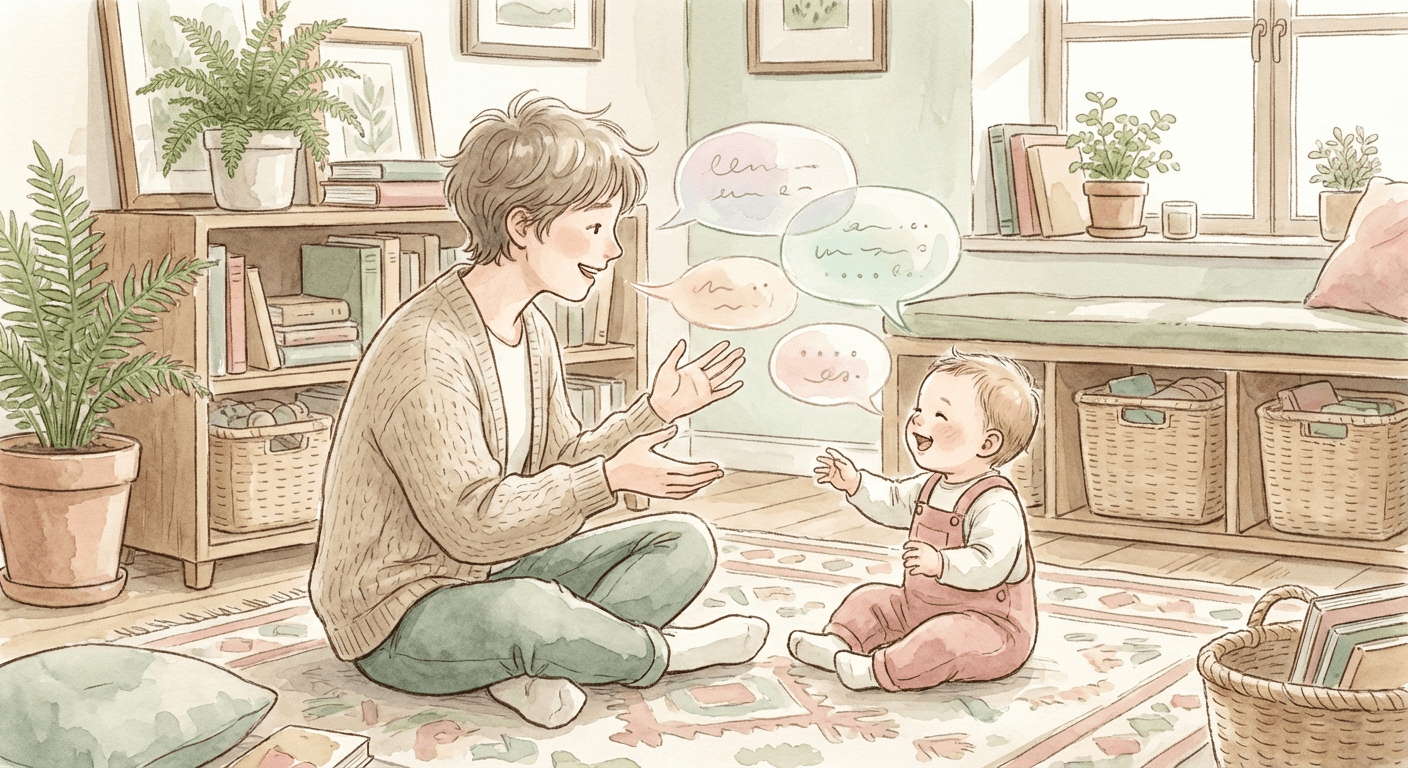
This is the big one. Treat your child as a conversational partner, even before they can talk. When your baby coos, coo back and wait. When your toddler points and says "da!" say "Yes! That's a dog! A big fluffy dog!" and pause for their response.
The TMW research found that parents in their program improved conversational turns with their toddlers by nearly four times compared to a control group. Four times. Just from learning to pause and wait.
Your Day Is Already Full of Language Opportunities
Here's what I love about this research: you don't need special toys, apps, flashcards, or dedicated "learning time." Your existing daily routine is a language goldmine. You just need to narrate it.
Speech therapists call this self-talk (narrating what you're doing) and parallel talk (narrating what your baby is doing). Here's what this looks like in real life:
Morning routine "Good morning, sweet girl! Let's change your diaper. It's wet — let's get a nice dry one. One, two, snaps! All done. Now let's pick out some clothes. How about this soft blue shirt?"
Mealtime "These bananas are so mushy and sweet! You're squishing them in your fingers — squish, squish, squish! Oh, you like the banana, huh? It's slippery!"
Bath time "Let's wash your toes! One, two, three, four, five little toes. Splash! The water is warm. Can you kick? Kick kick kick!"
Walks "Look at that big tree! The leaves are blowing in the wind. Oh, do you hear that? That's a bird singing. And there's a red car — vroom!"
It feels weird at first. But your baby doesn't think it's weird. To them, every word is a gift wrapped in your voice.
What About Reading? Yes — From Day One
A 2019 study from Ohio State University found that children whose parents read them five books a day entered kindergarten having heard approximately 1.4 million more words than children who were never read to. Even one book a day added up to a difference of nearly 300,000 words.
But before you panic about hitting a daily book quota, remember: it's not about the number. It's about the interaction.
Reading with your baby doesn't mean reciting every word on the page. Point at pictures. Let them turn pages. Ask "where's the cat?" and wait. The book is a prop. The conversation is the point.
Common Myths That Need Clearing Up
"If I just leave the TV on, my baby will absorb language"
Nope. Research consistently shows that babies learn language from live, interactive human exchanges, not from screens. Background TV can actually reduce the quantity and quality of parent-child conversation. Screens don't do serve-and-return. A real person does.
"Only 'smart' talk counts"
Talking about the clouds is just as valuable as teaching colours from a flashcard — probably more so, because it's happening in context, with genuine engagement. Narrating your messy, ordinary life is exactly the kind of language input your baby's brain is wired for.
"My baby can't understand me, so what's the point?"
Your baby's brain is processing language long before they understand words. Newborns already distinguish their mother's language from a foreign one. By six months, they're mapping specific speech sounds. Every word trains their brain's language networks, even when it looks like they're not listening.
"I need to hit 30 million words or I've failed"
That number was an extrapolation from a small study — never meant as a target. Five minutes of engaged conversation is worth more than an hour of talking at your child while scrolling your phone.
What If You're Not a "Talker"?
If narrating your day feels unnatural, that's okay. Some low-pressure ways in:
- Start with one routine. Pick diaper changes or meals and narrate just that.
- Sing instead. Songs are a natural entry point when talking feels forced.
- Read a book. Let the book give you the words. Just add pauses and pointing.
- Just respond. You don't have to initiate — return their serves. A coo for a coo.
- Give yourself grace. Silence is fine too. Your baby needs processing time.
As Dr. Suskind puts it: "It's not about being perfect. It's about being present."
Key Takeaways
- The original 30 million word gap study showed dramatic differences in early language exposure — but the real insight isn't about counting words
- MIT research found that conversational turns (back-and-forth exchanges) are a stronger predictor of brain development than total word count
- Your baby's brain builds neural pathways and myelination in response to language — it literally shapes brain architecture
- Use the Three T's: Tune In to your child's interests, Talk More using descriptive language, and Take Turns by pausing for their response
- Your daily routines (meals, baths, walks, diaper changes) are already language-rich opportunities — just narrate what's happening
- Reading and singing from birth are powerful, but the interaction matters more than the content — let your baby lead
You're Already Talking to Your Baby More Than You Think
Every "good morning," every narrated diaper change, every babble you return — you're building their brain. You don't need an app or a program. You just need to keep doing what you're probably already doing: talking to your baby like they matter. Because they do.
The 30 million word gap gave us an important wake-up call. But the real message isn't "talk more." It's "connect more." And that's something every parent can do, in every language, at every income level, starting right now.
So go ahead. Tell your baby about the laundry. Have a philosophical discussion about ceiling fans. Their brain is listening — even when their face says otherwise.
Stay in the loop
Weekly tips backed by science, delivered with love.
You might also like
Your Baby Doesn't Need Expensive Toys to Develop Well — Here's What They Need Instead
The baby toy industry is worth billions — but research shows the best brain-building tools are free. Here's what science…
Boys' Brains vs. Girls' Brains: What Neuroscience Actually Tells Us
Are boys really "wired" for trucks and girls for dolls? The science of sex differences in baby brains is way more nuance…