Synaptic Pruning Explained: Why Your Toddler's Brain Is Getting Smarter by Losing Connections
The Night I Learned That Less Can Be More
I was deep in a late-night scroll — the kind where you're nursing a baby and desperately Googling everything about brain development — when I stumbled across something that stopped me cold.
Your toddler's brain is deleting connections. Millions of them. Every single day.
My first reaction? Panic. Were the connections we'd been building through all those songs, books, and peek-a-boo marathons just… disappearing? Was something wrong?
Turns out, the opposite is true. Your toddler's brain is getting smarter *because* it's losing connections, not in spite of it. It's one of the most elegant processes in all of human development, and once you understand it, you'll never look at your toddler the same way again.
What Is Synaptic Pruning?
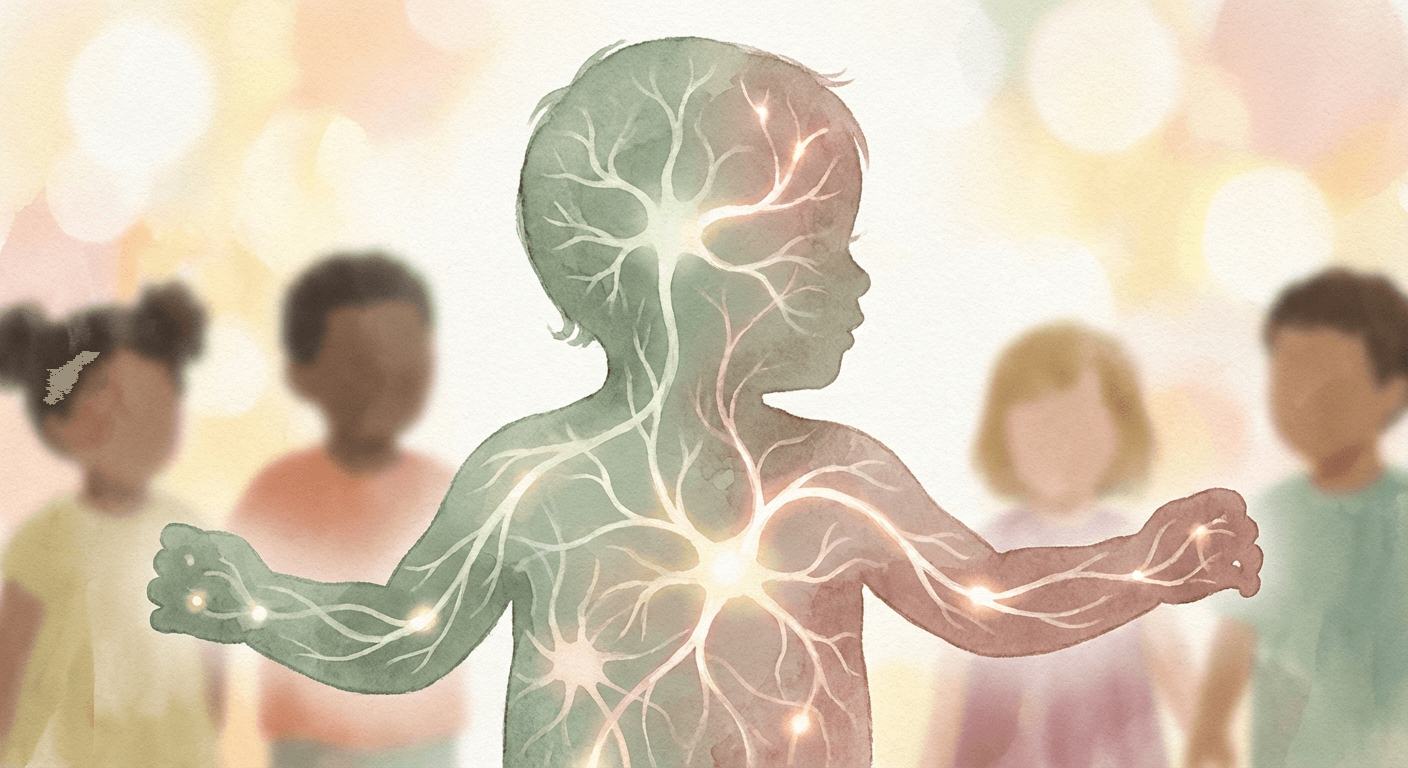
Let's start with the basics. Your baby was born with roughly 100 billion neurons — that's about as many as there are stars in the Milky Way. In those first years of life, these neurons started forming connections called synapses at a mind-blowing rate: over one million new connections every second, according to Harvard's Center on the Developing Child.
By the time your child is about two to three years old, their brain has reached its peak — somewhere around 1,000 trillion synaptic connections. That's roughly 50% more than you or I have in our adult brains.
But here's the thing: the brain didn't build all those connections because it needs all of them. It built them as possibilities. Think of it like sketching a rough draft — the brain creates a massive, sprawling network of connections, and then it starts editing.
Synaptic pruning is that editing process. It's the brain's way of looking at all those trillion-plus connections and asking: Which of these are actually being used? Which ones matter? The connections that get used regularly are strengthened and kept. The ones that don't? They're gradually dismantled and removed.
The neuroscientist Peter Huttenlocher was the first to carefully document this process in a landmark 1979 study. By examining brain tissue across different ages, he showed that synaptic density in the frontal cortex peaks around age one to two — about 50% higher than adult levels — and then steadily declines through childhood and into adolescence. The psychiatrist Irwin Feinberg gave this process its name in 1983: synaptic pruning.
The "Use It or Lose It" Principle
Synaptic pruning operates on one beautifully simple rule: use it or lose it.
Every time your toddler hears you talk, plays with blocks, splashes in the bath, or watches the dog run across the yard, they're activating specific neural pathways. Those pathways carry tiny electrical signals between neurons, and each activation strengthens the synapse — like a trail in the woods that gets clearer and wider the more people walk on it.
Connections that fire repeatedly become coated in myelin, a fatty insulation that makes signals travel faster and more efficiently. These are the pathways your toddler's brain decides to keep.
But what about the pathways that rarely get used? The ones formed for experiences that never happened, or skills that weren't practiced? Those connections gradually weaken. And eventually, the brain's clean-up crew comes along to remove them.
Meet the Clean-Up Crew: Microglia
This is where it gets genuinely cool. Your toddler's brain has its own dedicated demolition team: microglia, the brain's immune cells.
When a synapse is identified for removal, specific proteins — particularly ones from the complement system (like C1q and C3, which you might recognize from immune system biology) — essentially "tag" that synapse. Microglia then recognize the tag and engulf the synapse, breaking it down and recycling its components.
It's precise, efficient, and purposeful. Think of microglia as the Marie Kondo of your toddler's brain — holding up each connection and asking, Does this spark neural activity? If not, it goes.
Why Fewer Connections = A Smarter Brain
This might be the hardest part for parents to wrap their heads around. We're so wired (pun intended) to think that more is better — more toys, more flashcards, more enrichment activities. So the idea that your child's brain is removing connections sounds alarming.
But imagine a city where every building was connected to every other building by a road. You'd have millions of roads, but traffic would be a nightmare. Nothing would move efficiently. Now imagine that city removes the roads nobody uses and widens the highways everyone needs. Suddenly, everything flows.
That's what pruning does for your toddler's brain. By eliminating weak, redundant, or unnecessary connections, the remaining pathways become faster, stronger, and more efficient. The result:
- Better focus and attention — less neural "noise" competing for processing power
- Improved working memory — streamlined circuits can hold and manipulate information more effectively
- Sharper language processing — the pathways your toddler uses for speech get prioritized and refined
- More coordinated movement — motor circuits become precise instead of clumsy
Research shows that early experiences can influence the final number of retained synapses by as much as 25%. That's a huge window of influence — and it's shaped almost entirely by the world you create for your child.
The Gardening Analogy (Harvard's Favorite)
The Harvard Center on the Developing Child loves to compare brain development to gardening, and it's the analogy that finally made this click for me.
In the first years of life, the brain is like a garden in spring — everything is growing wildly and abundantly. Shoots and branches are heading in every direction. It's lush but chaotic.
Pruning is what turns that wild garden into something productive. A gardener doesn't cut back a rose bush because they hate roses. They prune to direct the plant's energy toward the strongest branches, the ones that will produce the best blooms.
Your toddler's brain is doing exactly the same thing. It's directing its limited energy and resources toward the neural pathways that matter most — the ones shaped by your child's actual experiences, relationships, and environment.
And here's the part that gave me goosebumps when I first read it: the brain is more flexible and responsive to experience during this period than at any other point in life. The architecture being built now — through both synapse formation and synapse elimination — forms the foundation for everything that comes after. Learning, emotional regulation, relationships, creativity — it all builds on this early scaffolding.
What Happens When Pruning Goes Wrong?
Science also tells us what happens when the pruning process doesn't work as expected, which helps us appreciate how important it is.
A groundbreaking 2014 study at Columbia University Medical Center, led by Guomei Tang and published in the journal Neuron, examined the brains of children with autism. The researchers found that while typically developing children showed a roughly 50% reduction in synaptic density by late childhood, children with autism showed only a 16% reduction. Their brains retained far more connections than expected.
The result wasn't enhanced ability — it was sensory overload and processing difficulties. Too many connections can be just as problematic as too few, because the brain can't efficiently route information through the noise.
This study was a powerful reminder: pruning isn't about loss. It's about optimization. A brain that prunes well is a brain that works well.
What You Can Do to Support Healthy Pruning
Here's the empowering part. You don't need special equipment, expensive programs, or a neuroscience degree. The most important things you can do are things you're probably already doing.
1. Talk, Sing, and Read — A Lot
Every word your toddler hears strengthens language pathways. Narrate your day, sing silly songs, read books even if they want the same one twelve times in a row (especially then — repetition strengthens connections). The pathways you activate through language are among the most important ones being refined during this period.
2. Follow Their Lead in Play
When your toddler is fascinated by a puddle, let them splash. When they want to stack blocks and knock them down thirty times, let them. Child-led play activates the neural pathways your child's brain is most ready to develop. You're essentially telling the brain: This connection matters. Keep it.
3. Prioritize Serve-and-Return Interactions
Those back-and-forth moments — your toddler babbles, you respond; they point, you name — are the single most brain-building activity available. Harvard's Center on the Developing Child calls serve-and-return interactions essential for healthy brain architecture. Each exchange strengthens connections for language, social skills, and emotional regulation.
4. Create a Rich but Not Overstimulating Environment
Your toddler needs variety — different textures, sounds, sights, and experiences. But they also need the chance to focus deeply on one thing. A few interesting objects beat a room crammed with toys. Quality of engagement matters more than quantity of stuff.
5. Protect Sleep
Sleep is when the brain does some of its most important consolidation and housekeeping work. During sleep, the brain strengthens the day's most-used pathways and clears out cellular waste. A well-rested brain prunes more effectively. Protecting nap times and bedtime routines is one of the best things you can do for your toddler's developing brain.
6. Be Present and Responsive
Your relationship with your child is the single biggest environmental influence on their brain development. When you respond to their needs consistently and warmly, you're telling their brain that the world is safe — and a brain that feels safe can devote its resources to learning and growing rather than staying on high alert.
Key Takeaways
- Synaptic pruning is a normal, essential process where your toddler's brain removes unused neural connections to become more efficient — it's a sign of healthy development, not loss
- Your child's brain peaks at roughly 1,000 trillion synapses around age 2-3, then gradually prunes to about 500 trillion by adolescence — the remaining connections are faster and stronger
- The process follows a "use it or lose it" rule: connections activated by your child's experiences are kept and strengthened; unused ones are removed by specialized brain cells called microglia
- Research shows that early experiences can influence the final number of retained synapses by up to 25%, making your everyday interactions incredibly powerful
- You don't need expensive programs — talking, reading, responsive play, and consistent routines are the most effective ways to support healthy pruning
- Too much or too little pruning can both cause problems, which is why a balanced, enriching (but not overstimulating) environment matters so much
Your Toddler's Brain Knows What It's Doing
I know it can feel unsettling to learn that your child's brain is actively dismantling connections. As parents, we want to build, build, build. The idea of anything being removed triggers that protective instinct.
But here's what I want you to take away from all of this: pruning is the brain's vote of confidence. It's the brain saying, I've surveyed the landscape. I know what matters here. Let me focus on what's important and let go of what isn't.
Every time you read that bedtime story, every time you name the colors at the grocery store, every time you get down on the floor and play — you're casting a vote for which connections stay. You're helping your toddler's brain decide what's worth keeping.
And the connections that aren't kept? They were never wasted. They were the rough draft that made the final version possible.
So the next time your toddler does something that makes you think, Wow, where did that come from? — a new word, a clever solution, a moment of surprising focus — remember: their brain didn't just build that ability. It pruned its way there.
Stay in the loop
Weekly tips backed by science, delivered with love.
You might also like
Your Baby Doesn't Need Expensive Toys to Develop Well — Here's What They Need Instead
The baby toy industry is worth billions — but research shows the best brain-building tools are free. Here's what science…
Boys' Brains vs. Girls' Brains: What Neuroscience Actually Tells Us
Are boys really "wired" for trucks and girls for dolls? The science of sex differences in baby brains is way more nuance…