Screen Time for Babies: An Evidence-Based Guide for Worried Parents
I Need to Confess Something
Last Tuesday, I had a deadline, a teething baby, and exactly zero hours of sleep. Did I hand over my phone with a YouTube Kids video playing? You bet I did. And then I spent the next 45 minutes googling "is screen time ruining my baby's brain" while eating cold toast.
If you've been there — frantically searching for answers while simultaneously feeling guilty about the very thing you're searching about — this guide is for you.
I'm not here to judge. I'm here to lay out what the research actually says, give you a clear age-by-age roadmap, and share strategies that work in the messy reality of parenting. Because the truth is both reassuring and important: what you do most of the time matters far more than what happens in a desperate Tuesday moment.
What the Experts Actually Recommend (and Why)
Let's start with the official guidelines, because they're clearer than most headlines suggest.
The American Academy of Pediatrics (AAP)
- Under 18 months: No screen time, except live video chatting with family
- 18–24 months: If you introduce screens, choose high-quality content and always watch together
- Ages 2–5: Maximum one hour per day of high-quality, educational programming
The World Health Organization (WHO)
- Under 1 year: No screen time at all
- Age 1: No sedentary screen time
- Age 2: No more than one hour, and less is better
Both organizations make the same exception: live video chatting is fine at any age. FaceTiming with grandma counts as social interaction, not passive screen time, because it's responsive, back-and-forth, and genuinely interactive.
These guidelines aren't arbitrary rules designed to make parents feel bad. They're based on decades of research into how young brains develop — and what they need most during these critical early years.
The Science Behind the Guidelines
So why are experts so cautious about screens for babies? Three key findings drive these recommendations.
Your Baby's Brain Can't Learn from Screens (Yet)
Researchers call it the "transfer deficit." Professor Rachel Barr at Georgetown University has spent years documenting this phenomenon: children under about three years old struggle to take what they see on a flat screen and apply it to the real, three-dimensional world.
In studies, toddlers who watched a video of someone hiding a toy couldn't find that toy in a real room — while toddlers who watched the hiding happen in person could. Their brains process screen-based information fundamentally differently from real-world experience.
This is why apps marketed as "educational" for babies are misleading. Your baby might be mesmerised, but the evidence tells us they're not learning what we hope they're learning. The AAP has been clear: the educational value of media for children under two remains unproven.
Screen Time Changes How the Brain Develops
A landmark longitudinal study from the National University of Singapore, tracking children from infancy into their teens, found something striking. Babies who had excessive screen exposure showed accelerated but inefficient maturation in brain networks responsible for visual processing and cognitive control.
Think of it like a plant growing too fast in a hothouse — it might look tall, but it's not as strong or flexible as one that grew at a natural pace.
These children showed slower decision-making at age eight and higher anxiety symptoms by age thirteen. The researchers emphasised that the period before age two is uniquely sensitive — screen exposure at ages three and four didn't show the same effects.
A related study using EEG scans on 18-month-olds found that those with more screen time at 12 months had stronger low-frequency brain waves — a pattern associated with reduced cognitive alertness.
It's Also About What Screens Replace
Perhaps the most important finding isn't about what screens do — it's about what they crowd out. Research shows that for every minute of screen time, young children engage in fewer back-and-forth interactions with their parents.
Those interactions — what scientists call "serve and return" — are the single most important ingredient for healthy brain development. When a screen is on, even in the background, parents speak fewer words, respond less to their baby's cues, and engage in less rich conversation.
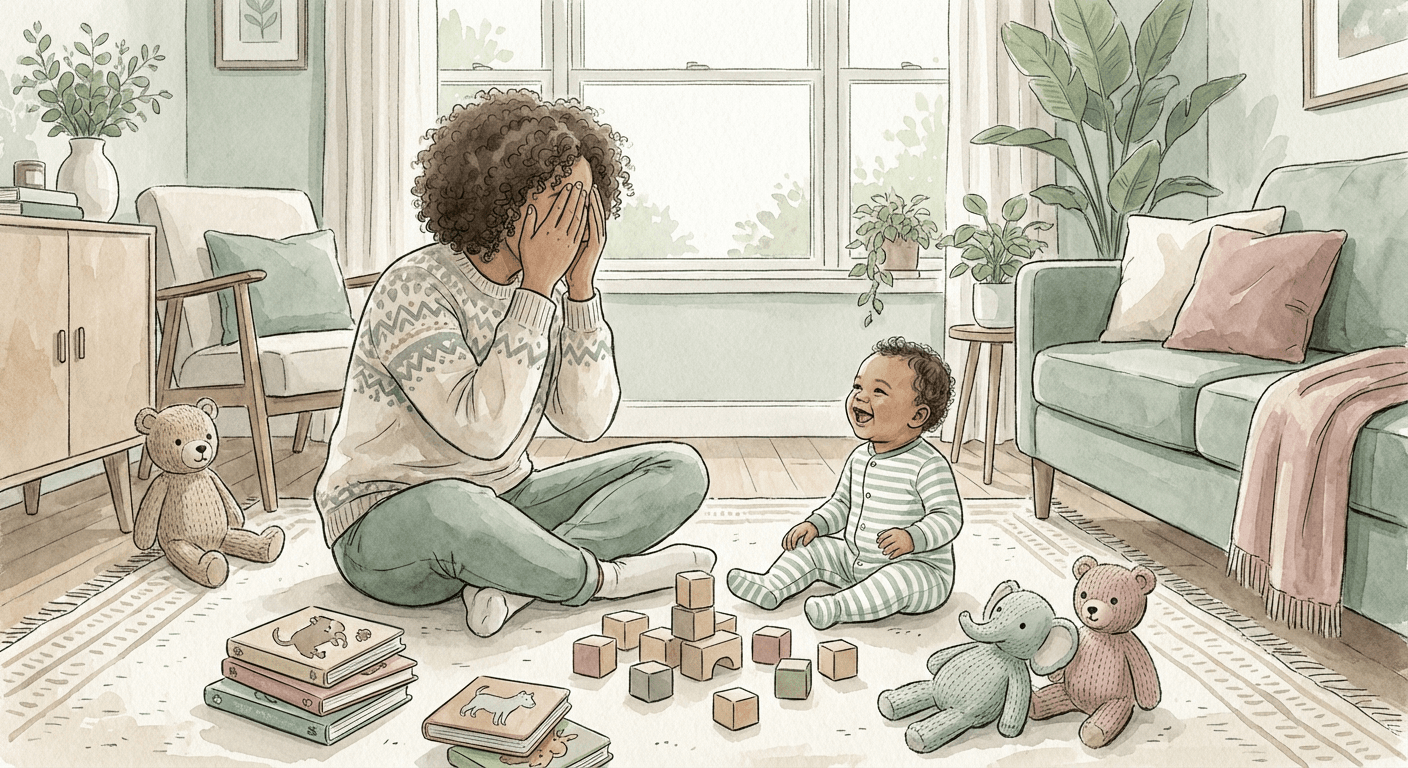
When I learned this, it honestly hit me harder than any brain scan study. All those little moments of narrating what I'm doing, responding to a babble, playing peekaboo — those are the building blocks. And screens can quietly steal them without us noticing.
Your Age-by-Age Action Plan
Here's where we get practical. Because knowing the science is one thing — living with it is another.
Birth to 12 Months: The Screen-Free Foundation
The goal: No screens (except video calls with family).
What to do instead: - Talk constantly. Narrate your day: "Now we're putting on your socks. These are the blue ones!" This is your baby's language university. - Read together. Even newborns benefit from hearing your voice reading a board book. It doesn't matter if they chew on it. - Sing and play music. Nursery rhymes, your favourite songs, silly made-up tunes — all of it counts. - Do tummy time. It builds more than muscles; it develops spatial awareness and problem-solving. - Let them explore. Wooden spoons, crinkly paper, stacking cups — simple objects teach cause and effect better than any app.
The honest truth: This stage is actually the easiest for screen-free living, because babies are fascinated by literally everything. A cardboard box is a five-star toy.
12 to 18 Months: Holding the Line
The goal: Still no passive screens. Video calls with family are great.
What to do instead: - Get outside. Nature is the ultimate sensory experience — leaves, grass, water, wind. - Build and knock down. Stacking blocks and watching them fall teaches physics and persistence. - Play pretend. Start simple: pretend to eat from an empty spoon, talk on a toy phone. - Make a mess. Water play, finger painting with yoghurt, squishing playdough — sensory play is brain food. - Involve them in life. Let them "help" with laundry, stir (safe) things in the kitchen, or water plants. Toddlers are desperate to participate in your world.
The realistic bit: This is when it gets harder. They're mobile, opinionated, and exhausting. When you need 10 minutes, try a box of tissues to pull out, a muffin tin with balls, or a kitchen drawer full of safe utensils.
18 to 24 Months: Introducing Screens (If You Choose To)
The goal: If you decide to introduce screens, keep it minimal, high-quality, and interactive.
How to make it count: - Choose slow-paced shows. Bluey, Daniel Tiger, and Sesame Street are designed with child development in mind. Avoid anything with rapid cuts, loud sounds, or flashing visuals. - Watch together — always. This is the single biggest thing you can do. Ask questions: "What colour is that?" Point things out. Pause and talk about what happened. Co-viewing turns passive watching into an interactive experience. - Keep sessions short. Ten to fifteen minutes is plenty. - No screens before bed. The stimulation and blue light can disrupt the sleep your toddler's brain desperately needs for consolidation.
Ages 2 to 3: Building Healthy Habits
The goal: Maximum one hour per day, and less is better.
Smart strategies: - Use a timer. Toddlers respond better to "when the timer goes off" than to you arbitrarily ending their show. - Create screen-free zones. No screens at meals, in bedrooms, or during the hour before bed. - Match screen content to real life. Watched an episode about sharing? Practice sharing during play. This helps bridge that transfer deficit. - Model what you want. If you're scrolling while telling them screens are limited, they notice. (Ouch — I know.) - Prioritise reading. The NUS study found that frequent parent-child reading at age three significantly weakened the link between infant screen time and altered brain development. Reading is genuinely protective.
What Counts as "Screen Time"?
This trips up a lot of parents, so let's clarify:
Counts as screen time: - TV shows and movies (even "educational" ones) - YouTube and streaming content - Apps and games on tablets or phones - Background TV that's on while baby is in the room
Doesn't count: - Live video calls with family or friends - You using your phone while baby sleeps (obviously — you're a person, not a monk)
The background TV trap: This one surprised me. Even if your baby isn't watching, a TV on in the background changes the room. Research shows it reduces how much you talk to your baby and how attentive you both are. Getting into the habit of turning it off when it's not being actively watched is one of the simplest, highest-impact changes you can make.
The Guilt Question
Let's address this head-on, because I know it's why many of you are reading this.
If your baby has already had screen time: Your baby is fine. The research looks at patterns and excessive use over time — not a single episode of Cocomelon during a meltdown. Brain development is built on thousands of interactions, and the loving, responsive care you provide every day is what matters most.
If you need screens sometimes to survive: That's called being a real parent. Single parents, parents with chronic illness, families in small apartments on rainy days — the "ideal" isn't always possible, and survival matters too. The goal isn't perfection. It's awareness and intention.
If your toddler is already used to lots of screen time: You can absolutely change course. Brains at this age are incredibly adaptable — that's the whole point of neuroplasticity. Gradually reduce screen time, introduce alternatives, and increase interactive play. It doesn't have to happen overnight.
Key Takeaways
- **Under 18 months:** No screens except live video calls with family — babies learn from real-world interaction, not screens
- **18–24 months:** If you introduce screens, keep it short, high-quality, and always co-view
- **Ages 2–3:** Limit to one hour per day of quality content; less is better
- **Video chatting is always fine** — it's interactive and social, which is what young brains need
- **Background TV counts** — turn it off when nobody's actively watching
- **Reading together is protective** — research shows it can moderate the effects of screen exposure
- **Guilt helps nobody** — what matters is your overall pattern of warm, responsive parenting, not a single desperate Tuesday
The Bigger Picture
Here's what I keep coming back to: the reason screens concern researchers isn't because they're some kind of brain poison. It's because the first three years of life are an extraordinary, unrepeatable window when your baby's brain is building its fundamental architecture — and it builds that architecture through you.
Your voice. Your face. Your silly songs and narrated diaper changes and games of peekaboo. That's what wires a brain.
Screens aren't the enemy. But they can quietly take up space where those irreplaceable moments could be. Being aware of that — and making intentional choices about it — is all any of us can do.
You're already here, reading about how to do right by your baby's brain. That tells me everything I need to know about the kind of parent you are. Trust yourself. You've got this.
Stay in the loop
Weekly tips backed by science, delivered with love.
You might also like
Your Baby Doesn't Need Expensive Toys to Develop Well — Here's What They Need Instead
The baby toy industry is worth billions — but research shows the best brain-building tools are free. Here's what science…
Boys' Brains vs. Girls' Brains: What Neuroscience Actually Tells Us
Are boys really "wired" for trucks and girls for dolls? The science of sex differences in baby brains is way more nuance…