Reading to Your Baby: When to Start, What to Read, and Why It Matters
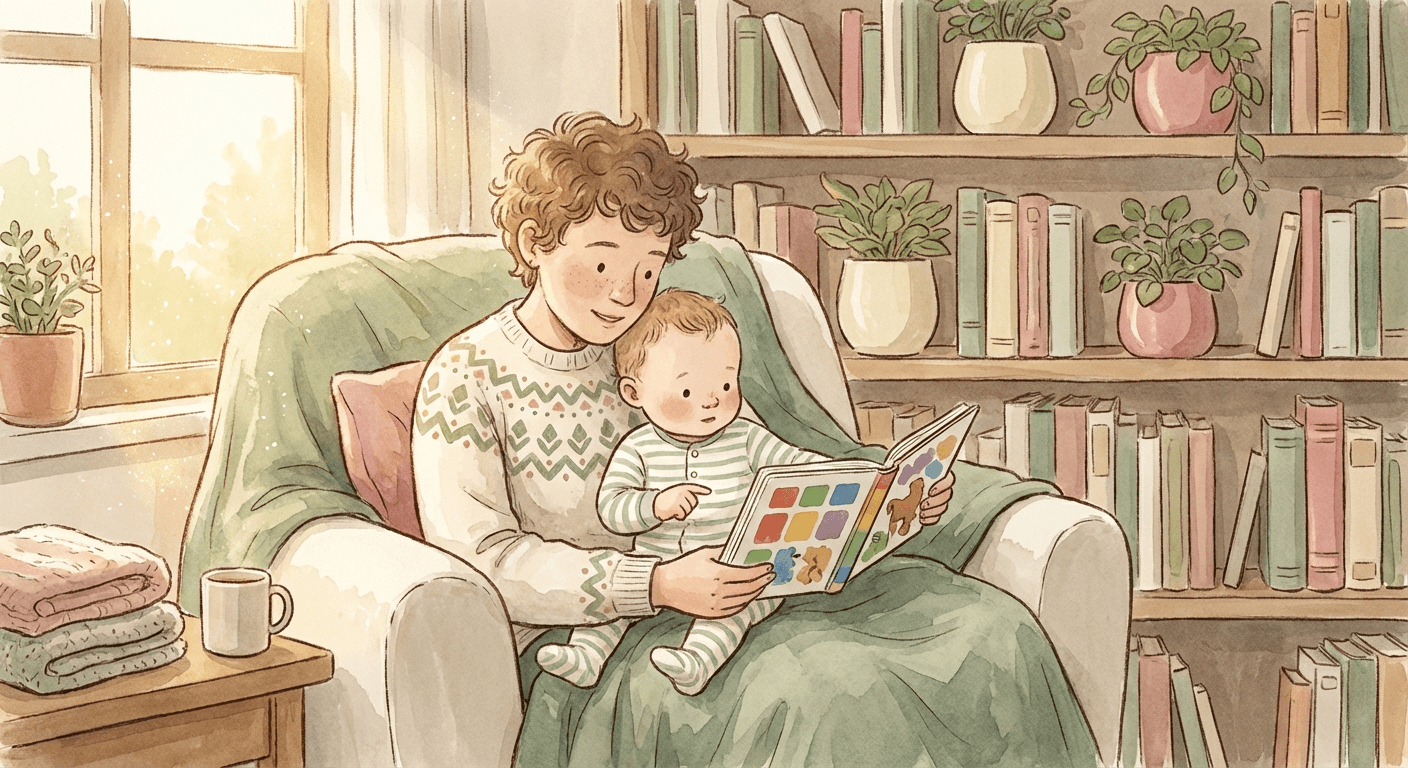
The Best Time to Start Reading to Your Baby? Earlier Than You Think
I'll never forget the moment a friend watched me read Goodnight Moon to my two-week-old and said, gently, "You know she can't understand any of that, right?"
I laughed. She wasn't wrong — my newborn definitely wasn't following the plot. But here's the thing my friend didn't know, and honestly, neither did I at first: understanding the words isn't the point. Not yet. What matters is that your baby's brain is listening, building, and growing with every page you turn.
The American Academy of Pediatrics now recommends that parents start reading aloud from the day their baby is born — even in the NICU when possible. That's not wishful thinking. It's based on brain scans, longitudinal studies, and decades of evidence showing that shared reading is one of the most powerful things you can do for your child's developing brain.
So if you've been wondering whether it's too early, what books to pick, or whether it "counts" when your baby would rather chew the pages — this one's for you.
What Happens in Your Baby's Brain When You Read
Your baby's brain is building itself at a breathtaking pace. In the first few years of life, it's forming over 700 to 1,000 new neural connections every single second, according to Harvard's Center on the Developing Child. These connections are the foundation for everything — language, memory, emotional regulation, problem-solving.
And reading aloud? It's rocket fuel for that construction project.
Dr. John Hutton, a pediatrician and researcher at Cincinnati Children's Hospital, used MRI brain imaging to study what happens inside young children's brains during reading experiences. His landmark 2015 study found that children who were read to more at home showed significantly greater brain activation in areas critical for language processing, mental imagery, and early reading skills — specifically in the left hemisphere, which handles semantic processing and comprehension.
But it gets even more interesting. In a 2017 follow-up published in The Journal of Pediatrics, Hutton found that it wasn't just whether children were read to — it was how. When parents read interactively — pointing at pictures, asking questions, responding to their child's reactions — the brain lit up even more, activating areas supporting complex language, executive function, and social-emotional processing.
In other words, every time you hold your baby close and read a story, you're not just sharing words. You're physically shaping their brain architecture.
The "Goldilocks Effect": Why Simple Picture Books Are Perfect
Here's something that genuinely relieved me as a parent: when it comes to books for little ones, simple is better.
Dr. Hutton's research team discovered what they call the "Goldilocks Effect" in reading formats. When they scanned children's brains while they experienced stories in different formats — audio only, static illustrations with words, and animated versions — the results were striking:
- Audio only (no pictures) created too much "strain" on language-processing pathways — young brains had to work too hard to make sense of the story without visual support
- Animated versions overstimulated the visual networks, making it harder for the brain to integrate language and images
- Static picture books with words read aloud were the sweet spot — providing just the right balance for the developing brain to integrate what it was hearing with what it was seeing
So those humble board books with simple illustrations? They're not boring. They're neurologically optimal. (I wish someone had told me this before I spent $40 on a "sensory-enhanced interactive learning book" that my baby completely ignored in favour of a $5 board book about a duck.)
Research consistently confirms that print books outperform tablets and e-books for young children. A University of Michigan study found significantly more verbal interaction between parents and toddlers when reading physical books versus tablet apps. The bells and whistles of digital books actually distract from the interaction that matters most.
The Million-Word Advantage
If the brain science doesn't convince you, the vocabulary numbers might.
Researchers at Ohio State University calculated that children whose parents read them five books a day enter kindergarten having heard approximately 1.4 million more words than children who were never read to. Even reading just one book a day gives your child an advantage of about 290,000 extra words by age five.
Think about that. Not 290,000 hours of vocabulary flashcards. Just one story a day, snuggled up together.
The words in children's books are richer and more varied than everyday conversation. We don't typically say "mischievous" or "enormous" or "beneath the twinkling stars" while folding laundry. But those words show up in picture books constantly, giving your child's brain access to a wider vocabulary than speech alone provides.
And the earlier you start, the bigger the impact. A 2023 study from Marshall University, published in Pediatrics, found that parents who began daily, consistent reading to their babies starting as young as two weeks old saw measurable improvements in language scores by nine months. Nine months! Before most babies even say their first word, reading was already making a detectable difference.
What to Read: An Age-by-Age Guide
You don't need a library science degree — just a sense of what works at each stage.
Newborns to 6 Months: It's All About Your Voice
Your baby's vision is still developing, but they can hear your voice, feel your closeness, and absorb the rhythm and melody of language.
Best book choices: - High-contrast board books — bold black-and-white patterns capture developing eyes - Rhyming books and poetry — the rhythmic, musical quality helps wire language-processing pathways - Books with simple, repetitive text — repetition helps your baby's brain recognise speech patterns - Honestly, anything you're reading yourself — at this age, your voice matters more than the content. I read my baby articles from my phone, recipes, even my own to-do lists out loud. It all counts.
6 to 12 Months: Getting Interactive
Now things get fun. Your baby can see colours, grab objects, and is starting to connect words with meanings. They'll want to participate.
Best book choices: - Touch-and-feel books — different textures stimulate sensory development and keep little hands engaged - Lift-the-flap books — the element of surprise supports memory and attention (and babies find them absolutely hilarious) - Board books with bold, colourful images — faces, animals, everyday objects they recognise - Books with mirrors — babies are fascinated by their own reflection, and it supports developing self-awareness
Pro tip: Let them chew the book. Mouth it. Bend the pages. This is how they explore at this age, and sturdy board books are designed to survive it. Don't stress about "proper" reading — this is sensory learning.
12 to 36 Months: The Language Explosion
Toddlerhood is when reading shows its magic. Vocabulary is exploding, and your child will start requesting favourites on repeat (prepare for reading the same book 47 times — it's actually great for their brain).
Best book choices: - Simple stories with repetitive phrases — "Brown Bear, Brown Bear" types where your toddler can fill in words - Books about daily routines — eating, sleeping, playing, going to the park. They love recognising their own world - Concept books — colours, numbers, shapes, animals. Naming builds vocabulary at lightning speed - Books with questions built in — "Can you find the cat?" "What sound does a cow make?" These naturally create the back-and-forth interaction that builds brains
The magic word for this age? Repetition. When your toddler wants the same story again, their brain is reinforcing neural pathways, deepening comprehension, and gaining mastery. Every re-read is a brain workout.
How to Read: Making the Most of Story Time
The way you read matters as much as what you read. Researchers have identified specific techniques that supercharge the brain-building benefits of shared reading.
Try Dialogic Reading
Dialogic reading is a technique where you turn reading into a conversation rather than a performance. Instead of just reading the words on the page, you:
- Ask open-ended questions — "What do you see?" "What do you think happens next?"
- Let them fill in blanks — pause before a familiar word and let your toddler supply it
- Connect the story to their life — "Look, a dog! Just like our dog, Max!"
- Expand on their responses — if they say "doggy," you say, "Yes! A big brown doggy running in the park"
Research shows dialogic reading significantly boosts vocabulary and comprehension across diverse populations, income levels, and languages.
Remember the techniques with the acronym CROWD: Completion prompts, Recall questions, Open-ended questions, Wh- questions (who, what, where, why), and Distancing (connecting the book to real life).
Make It a Serve-and-Return Experience
The Harvard Center on the Developing Child's "serve and return" framework applies beautifully to reading. When your baby points at a picture (serve), you name it (return). When your toddler says a word from the story (serve), you expand on it (return). These exchanges — even tiny ones — are building neural connections every time.
Don't Worry About "Finishing" the Book
Full disclosure: my baby's attention span at six months meant we "read" approximately three pages before the book became a chew toy. I felt like I was failing at reading time.
I wasn't. And neither are you. There is no rule that says you have to read every page. For babies, flipping through, pointing at one picture, reading a single page — it all counts. A 2023 study confirmed that even short, consistent daily reading sessions produced measurable language benefits. Consistency beats duration every time.
Reading Programs That Can Help
The Reach Out and Read program, integrated into pediatric well-child visits, gives families age-appropriate books and reading guidance. Children in the program score 3 to 6 months ahead on vocabulary tests, and parents are 2.5 times more likely to read regularly. Ask your pediatrician if your practice participates.
Common Concerns (That You Can Stop Worrying About)
"My baby doesn't seem interested." Totally normal, especially under 6 months. They're absorbing more than you think. Keep sessions short and pressure-free.
"They just want to eat the book." That's exploration. It's developmentally appropriate. Let them mouth the board book and try again later.
"We don't have many books." Libraries are free, and re-reading the same few books is actually ideal — repetition strengthens neural pathways. Five well-loved books beat fifty untouched ones.
"I don't know how to make it interactive." Start simple. Point at pictures. Name things. Pause and see if your baby reacts. That's interactive reading. You're already doing it.
"Is it too late to start?" Not at all. The brain's plasticity in the first three years means starting at any point delivers benefits.
Key Takeaways
- The **AAP recommends reading aloud from birth** — your baby benefits from your voice long before they understand words
- MRI research shows reading activates **critical brain regions** for language, comprehension, and executive function in young children
- Children read just **one book a day** hear approximately **290,000 more words** by age five than children not read to at all
- **Simple board books with static pictures** are neurologically optimal for babies and toddlers — no need for fancy digital or animated alternatives
- **Interactive reading** (asking questions, pointing, pausing) builds more brain connections than simply reading the text aloud
- **Consistency matters more than duration** — even a few minutes of daily reading produces measurable language gains
The Simplest Gift You Can Give
When I think about all the parenting decisions that keep me up at night — sleep training, screen time, nutrition, milestones — reading is the one thing that never feels complicated. There's no downside. No controversy. No expensive equipment. Just you, your baby, and a book.
The research is so clear it's almost boring in its consistency: reading to your child from the very beginning changes their brain for the better.
So tonight, grab a board book — or a novel, or a cereal box, honestly — and read to your baby. It doesn't need to be perfect or long. Just you, sharing words with the little person whose brain is listening to every single one.
That's more than enough. That's everything.
Stay in the loop
Weekly tips backed by science, delivered with love.
You might also like
Your Baby Doesn't Need Expensive Toys to Develop Well — Here's What They Need Instead
The baby toy industry is worth billions — but research shows the best brain-building tools are free. Here's what science…
Boys' Brains vs. Girls' Brains: What Neuroscience Actually Tells Us
Are boys really "wired" for trucks and girls for dolls? The science of sex differences in baby brains is way more nuance…