Left Brain vs. Right Brain in Babies: What Science Actually Says
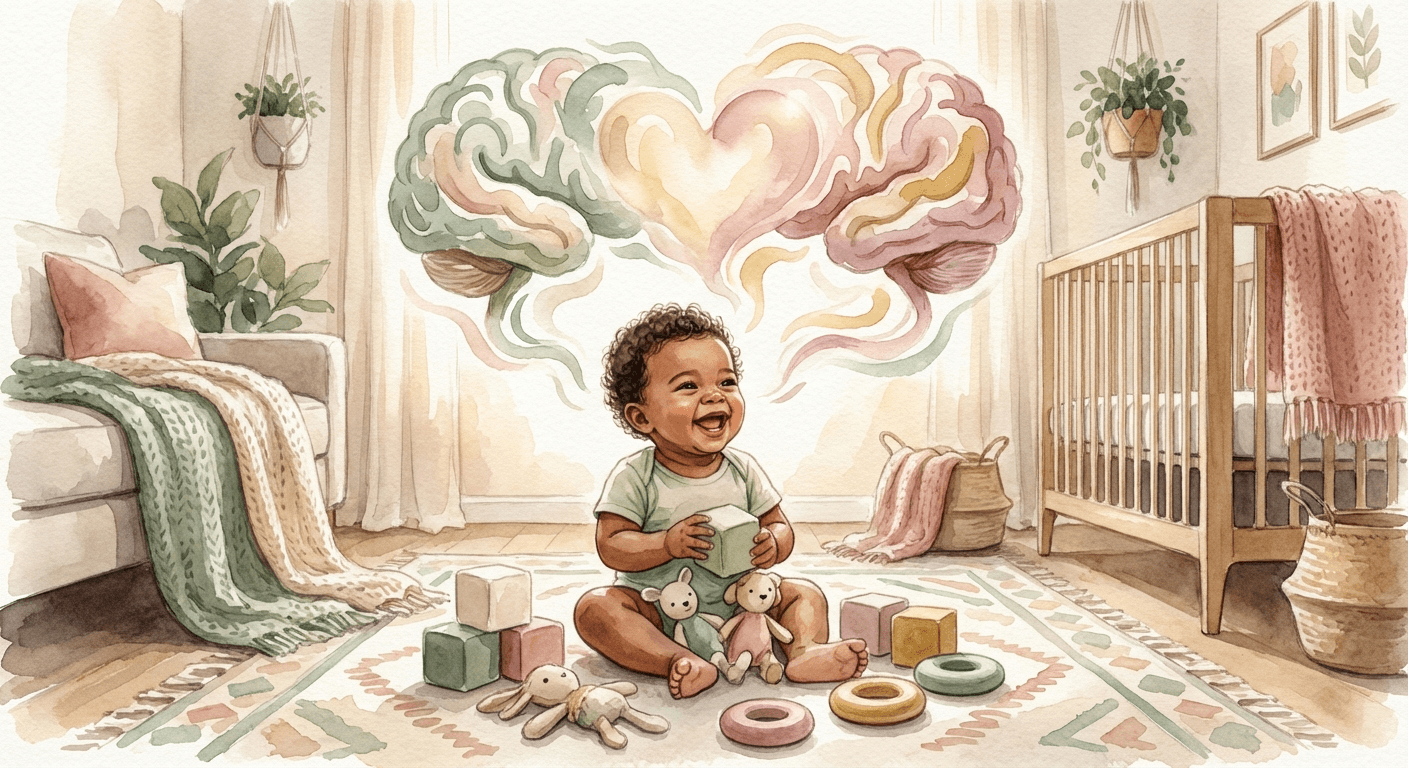
"So, Is She a Left-Brain Baby or a Right-Brain Baby?"
My mother-in-law asked me this when my daughter was about six months old, watching her stack and knock over soft blocks for the fifteenth time in a row. "She's so methodical! Must be left-brained, like her dad."
I smiled and nodded, because I'd honestly believed the same thing for most of my life. Left brain = logical, analytical, good at math. Right brain = creative, intuitive, good at art. It's one of those ideas that just feels true. It's everywhere — in parenting books, personality quizzes, even preschool marketing ("nurture your child's right brain!").
But here's the thing: it's a myth. A persistent, wildly popular myth — but a myth all the same.
And what's actually happening in your baby's brain? It's so much cooler.
Where the Myth Came From
The left-brain/right-brain idea didn't come out of nowhere. It started with real science — science that got stretched way beyond what it actually showed.
In the 1960s, neuroscientist Roger Sperry studied patients with severe epilepsy whose corpus callosum (the thick bundle of nerve fibers connecting the two brain hemispheres) had been surgically cut. In these "split-brain" patients, the two halves of the brain literally couldn't talk to each other anymore.
Sperry's experiments revealed something genuinely fascinating: each hemisphere had strengths. The left hemisphere was better at language and analytical tasks. The right was better at spatial reasoning and recognizing patterns. This groundbreaking work earned Sperry a Nobel Prize in 1981.
But here's where things went sideways. Pop psychology grabbed these findings and ran with them — transforming "certain brain functions are somewhat specialized" into "people are either left-brained or right-brained." Self-help books, corporate workshops, and eventually the parenting industry all jumped on board.
The actual scientists? They never said that.
What the Science Actually Shows
In 2013, a team at the University of Utah decided to put the left-brain/right-brain theory to the test in a big way. They analyzed brain scans of 1,011 people between the ages of 7 and 29, looking specifically at whether individuals showed a pattern of using one hemisphere more than the other.
Their conclusion was definitive: there is no evidence that people are globally "left-brained" or "right-brained."
Yes, certain functions tend to be handled more by one side. Language processing, for example, leans left in most people. Attention tends to involve the right hemisphere more heavily. But — and this is the crucial part — no one's entire brain leans one way. The lateralization is specific to individual neural networks, not to whole brains or whole people.
As lead researcher Dr. Jeff Anderson put it: brain lateralization is a property of specific networks, not a personality type.
How Your Baby's Brain Actually Works (It's Better Than the Myth)
Here's what makes the reality so much more impressive than the myth: your baby's brain uses both hemispheres *more* than yours does.
A landmark 2020 study from Georgetown University used brain imaging to compare how children and adults process language. In adults, language processing is heavily concentrated in the left hemisphere. But in young children? Both hemispheres light up.
Researchers Elissa Newport and Olumide Olulade found that children under 10 or 11 years old show significant bilateral activation — meaning both sides of the brain are pitching in to understand language. It's only as the brain matures that processing becomes more lateralized to one side.
And here's why that's actually incredible: this bilateral processing may be one of the reasons children recover from brain injuries so much better than adults. If a young child's left hemisphere is damaged, their right hemisphere can step in and handle language processing in a way that an adult brain simply can't.
Your baby's brain isn't "left" or "right." It's all in. Both hemispheres are actively engaged, constantly collaborating, building connections at a pace that will never be matched again in their lifetime.
The Corpus Callosum: Your Baby's Neural Superhighway
If the two hemispheres are the cities, the corpus callosum is the superhighway connecting them. And it's massive — containing over 200 million nerve fibers, making it the largest white matter structure in the brain.
In your baby, this superhighway is under active construction:
- It begins forming between 8 and 20 weeks of pregnancy
- At birth, it's relatively thin and unmyelinated (meaning the signal-boosting insulation isn't fully in place yet)
- Myelination begins around 4 months of age, dramatically speeding up communication between the hemispheres
- By 8 months, it starts to look structurally similar to an adult's corpus callosum (just smaller)
- It continues developing and myelinating well into adolescence
I remember learning about the corpus callosum and suddenly seeing my baby's development differently. Every new skill — reaching across her body, coordinating both hands, eventually reading and reasoning — depends on these two hemispheres talking to each other. It's not about one side winning. It's about building the bridge.
What This Means for the "Right-Brain Parenting" Trend
You may have seen products, programs, or books promising to "develop your child's right brain" — or left brain, for that matter. Now that you know the science, you can probably see the problem.
There's no scientific basis for targeting one hemisphere. Here's why:
- Almost every activity engages both hemispheres simultaneously
- Playing with blocks? That involves spatial processing (right-leaning) and planning and sequencing (left-leaning) and language if you're talking about what you're building
- Singing a song? Language centers (left-leaning), melody and pitch processing (right-leaning), emotional processing (both), motor control for clapping along (both)
- Drawing a picture? Spatial awareness (right-leaning), fine motor planning (left-leaning), creative ideation (distributed across both hemispheres)
The brain is an integrated system. Trying to train "one side" is like trying to clap with one hand. It misses the entire point of how the brain works.
What about handedness?
You might be wondering: "But what about being right-handed or left-handed? Doesn't that prove hemispheric dominance?"
Handedness does relate to brain organization — motor control is cross-lateralized, meaning your right hand is primarily controlled by the left hemisphere and vice versa. Most babies start showing a hand preference during their first year, with stable handedness typically emerging by 18 months.
But handedness is a specific motor preference, not evidence of whole-brain dominance. Your right-handed toddler isn't "left-brained." They just have a motor preference. Their brain is happily using both sides for everything from language to problem-solving to figuring out how to get the lid off the container you definitely thought was childproof.
What You Can Do Instead (Evidence-Based Tips)
Forget about left brain vs. right brain. Here's what actually helps your baby's whole brain thrive:
1. Talk, sing, and read — a lot Language is one of the most powerful brain-builders, and in young children, it engages both hemispheres. You don't need fancy vocabulary cards. Just **narrate your day, sing silly songs, and read together.** The back-and-forth of conversation — what researchers call "serve and return" — is pure neural gold.
2. Encourage cross-body movement Activities that cross the body's midline (reaching the right hand to the left side and vice versa) help strengthen the corpus callosum. **Crawling is one of the best natural cross-body activities** — so don't rush your baby to walk. Let them crawl as long as they want.
3. Offer varied, open-ended play Blocks, art supplies, music, nature exploration, water play, pretend play — variety is key. Different types of play engage different neural networks across *both* hemispheres. **The more varied the experience, the more connections get built.**
4. Don't label your child Resist the urge to categorize your toddler as "the logical one" or "the creative one." These labels can become self-fulfilling prophecies. **Children are naturally both logical and creative** — their brains are wired to be. Give them room to be all of it.
5. Prioritize responsive interaction The Harvard Center on the Developing Child consistently identifies responsive, serve-and-return interactions as the single most important factor in healthy brain development. **No product, app, or program comes close to the brain-building power of a present, responsive caregiver.**
6. Protect sleep Sleep is when the brain consolidates learning and strengthens connections — including those crucial cross-hemisphere pathways. **A well-rested brain is a well-connected brain.**
Key Takeaways
- The idea that people are "left-brained" or "right-brained" is a myth — no scientific evidence supports it
- Your baby's brain actually uses both hemispheres MORE equally than an adult's, which is a feature, not a bug
- The corpus callosum (200+ million nerve fibers connecting the hemispheres) is under active construction throughout childhood
- Almost every activity — from block play to singing — engages both hemispheres simultaneously
- Skip the "right-brain training" products and focus on what actually works: talking, reading, varied play, and responsive interaction
- The best brain-building strategy isn't targeting one hemisphere — it's building the bridge between them
The Real Story Is Better Than the Myth
I get the appeal of the left-brain/right-brain idea. It's neat and tidy. It gives us a framework for understanding our kids (and ourselves). And honestly? It's just kind of fun — like a personality quiz for your brain.
But the real story of how your baby's brain works is so much more impressive. Two hemispheres, billions of neurons, hundreds of millions of connecting fibers, all working together in a coordinated dance of development that's unlike anything else in nature.
Your baby isn't left-brained or right-brained. They're whole-brained. And that's exactly what they're supposed to be.
Every time you get down on the floor and play, every time you chat during a diaper change, every time you point out a bird on a walk — you're not building the left brain or the right brain. You're building the whole, magnificent thing.
And that, to me, is even better.
Stay in the loop
Weekly tips backed by science, delivered with love.
You might also like
Your Baby Doesn't Need Expensive Toys to Develop Well — Here's What They Need Instead
The baby toy industry is worth billions — but research shows the best brain-building tools are free. Here's what science…
Boys' Brains vs. Girls' Brains: What Neuroscience Actually Tells Us
Are boys really "wired" for trucks and girls for dolls? The science of sex differences in baby brains is way more nuance…