Is My Baby a Genius? The Truth About Early Signs of Intelligence
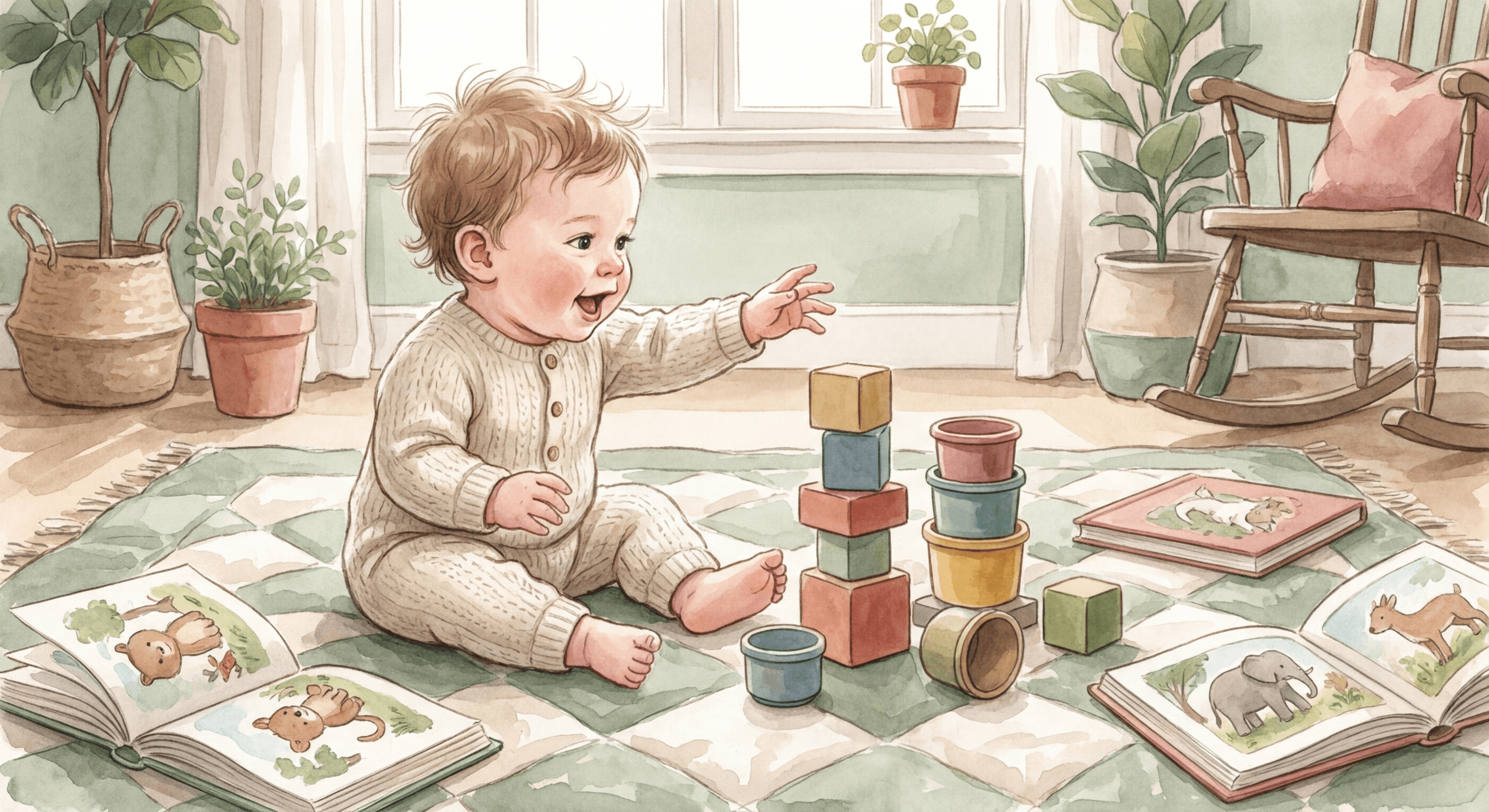
I Definitely Googled This at 3am
My baby rolled over early. Like, suspiciously early. And within about twelve seconds of it happening, I was deep in a Google rabbit hole: "early rolling sign of intelligence?" "gifted baby milestones" "is my baby advanced?"
I'm not proud of it. But I'm also not going to pretend it didn't happen, because I know I'm not the only parent who's done this.
Maybe your baby said their first word at 8 months. Maybe they figured out how to open the baby gate before their first birthday. Maybe they seem to understand things you say before other babies do. And suddenly you're wondering: is my baby... a genius?
The internet is happy to fuel this. Lists of "10 Signs Your Baby Is Gifted" — early smiling, intense eye contact, reaching milestones ahead of schedule. It all feels very scientific.
But here's what the actual science says: we are remarkably bad at predicting intelligence in babies. And the obsession with trying to do so might actually be working against our kids.
Let me explain.
Why We Can't Really Measure Baby Intelligence
Let's start with the most uncomfortable truth: the tools we have for measuring infant intelligence are not very good at predicting future intelligence.
The most widely used assessment is the Bayley Scales of Infant and Toddler Development (BSID), which evaluates motor skills, language, and cognitive abilities in children up to 42 months. It's the gold standard for identifying developmental delays — and it's genuinely useful for that purpose.
But here's the catch: it's designed to assess current developmental functioning, not predict future brilliance.
The numbers tell the story. A study published in Pediatrics (the journal of the American Academy of Pediatrics) found that Bayley scores at 20 months had poor positive predictive validity for school-age cognitive functioning. Another study found that only 2 out of 36 children identified as gifted at age 7.5 had scored in the gifted range on the Bayley Scales as infants.
Let that sink in. Thirty-four out of thirty-six gifted kids would have been missed if we'd tried to identify them as babies.
A 2024 study published in BMJ Open found that Bayley scores at age 2 explained only about 15% of the variation in full-scale IQ at age 4 — and as little as 1% of the variation in fluid reasoning at age 8. That's essentially no predictive value at all for the kind of thinking most people associate with being "smart."
Why Are Baby Tests So Bad at Predicting?
They measure completely different skills. Infant tests assess reaching, visual tracking, and stacking blocks. Adult intelligence involves abstract reasoning and verbal comprehension. These are fundamentally different cognitive domains.
Baby brains are wildly unstable. Cognitive abilities in very young children can shift dramatically over months or even weeks. A baby who's teething or tired might score completely differently the next day. Stability in cognitive test scores doesn't emerge until late elementary school.
So much development hasn't happened yet. Language, executive function, self-regulation — the building blocks of what we eventually call "intelligence" are still years from maturing. Trying to measure adult-type intelligence in a baby is like reviewing a movie based on the opening credits.
The Genetics of Intelligence: It's Not What You Think
Many parents assume intelligence is mostly genetic — that your baby either got the "smart genes" or they didn't. But the science is far more nuanced, especially in early childhood.
Twin studies — the gold standard for separating genetic from environmental influences — have found something fascinating: the heritability of intelligence in infancy is only about 20%. That means roughly 80% of the variation in infant cognitive ability comes from the environment.
This is dramatically different from adulthood, where heritability rises to 60-80% — a phenomenon called the Wilson Effect. But in babyhood? The environment is running the show. The quality of parent-child interactions, language exposure, socioeconomic factors, and stress levels account for a massive proportion of cognitive variation in the first two years.
A landmark twin study of over 1,000 twins found that measures taken at just 7 months of age could predict only about 13% of the variance in adult cognitive scores at age 30. The strongest predictors weren't the things you might expect — they were novelty preference (being interested in new things) and task orientation (being able to focus on an activity). Not early talking. Not early walking. Not early anything that typically ends up on "signs of a genius baby" listicles.
What does this mean practically? It means the environment you're creating for your baby right now matters enormously. And it means that an early milestone — or a late one — tells you very little about your child's long-term potential.
The Problem With "Signs of a Gifted Baby" Lists
You've seen them. Every parenting website has one. "Signs your baby might be gifted" — and they include things like intense alertness, early smiling, long attention span, reaching milestones early, and unusual sensitivity to sounds or textures.
Here's the problem: most of these are completely normal variations in development. Some babies are more alert. Some smile earlier. Some are more sensitive. These are temperamental traits as much as cognitive ones — and on their own, they don't reliably predict future intelligence.
Researchers have found that while groups of children later identified as gifted may show slightly advanced development in infancy, the differences are too small to be clinically meaningful for individual children. A baby who walks at 9 months isn't necessarily smarter than one who walks at 14 months. They might just be more motivated to move.
The really dangerous part is what happens when parents — with the best of intentions — start treating early milestones as evidence of giftedness.
Why Labeling Your Baby "Smart" Can Backfire
Stanford psychologist Carol Dweck has spent decades studying what happens when we label children's intelligence — and her findings should make every parent pause.
In her landmark study, Dweck gave fifth-graders an easy puzzle, then praised one group for their intelligence ("You must be really smart") and another for their effort ("You must have worked really hard").
The results were dramatic:
- 67% of the "smart" group chose an easier puzzle next — they didn't want to risk looking less smart. 92% of the "effort" group chose the harder one.
- Faced with a difficult puzzle, the "smart" group gave up quickly and their performance dropped 20%. The "effort" group? Scores improved by 30%.
- The "smart" group became more interested in how they compared to others rather than in learning itself.
The implications are profound: telling children they're smart can actually make them less resilient, less motivated, and less willing to take on challenges. And Dweck's broader work shows these patterns begin forming much earlier than we realize — the language we use with toddlers starts shaping their self-concept from the very first years.
When I learned this, I completely rethought how I talk about my child's accomplishments. Instead of "You're so smart!" I started saying things like "You worked so hard on that!" or "You didn't give up — look what happened!" It felt awkward at first. Now it's second nature.
Intelligence Isn't One Thing (And That Matters)
Another reason the "is my baby a genius?" question is flawed is that it assumes intelligence is a single, measurable thing. It's not.
Even within cognitive science, researchers distinguish between fluid intelligence (solving novel problems), crystallized intelligence (accumulated knowledge), processing speed, and working memory. These are somewhat independent, develop on different timelines, and are influenced by different factors. A baby who seems "advanced" might be showing strength in one narrow area while being perfectly average in others. That's not giftedness — that's normal human variation.
The Harvard Center on the Developing Child frames it beautifully: brain architecture is built through an ongoing process that begins before birth and continues into adulthood. Genes provide the blueprint, but experiences — especially the quality of relationships and interactions in the early years — literally sculpt how those neural circuits are wired and reinforced.
Your baby isn't a finished product. They're a work in magnificent progress.
What Actually Matters More Than "Early Signs"
So if we can't (and shouldn't) try to determine whether our baby is a genius, what should we focus on instead? The science is actually beautifully clear on this.
1. Responsive Relationships
The Harvard Center on the Developing Child identifies "serve and return" interactions as the single most important factor in healthy brain development. When your baby coos and you coo back, when they point and you name the thing, when they cry and you comfort them — you're building neural architecture in real time. No amount of early milestone-hitting can replace this.
2. Language-Rich Environments
The sheer quantity and quality of language a baby hears in the first three years is one of the strongest predictors of later academic success — far stronger than any early milestone. Talk to your baby. Narrate your day. Read books. Sing songs. It doesn't have to be educational content. It just has to be words, directed at them, with warmth.
3. Play
Play isn't a break from learning — it IS learning. A 2022 meta-analysis from the University of Cambridge examining 39 studies found that guided play outperformed direct instruction across multiple cognitive domains including math, spatial reasoning, and cognitive flexibility. When your baby stacks blocks and knocks them down for the hundredth time, their brain is running experiments about gravity, cause and effect, and prediction.
4. Emotional Safety
Chronic stress — the kind caused by unstable environments, harsh discipline, or persistent neglect — can physically alter brain architecture through toxic stress responses. Conversely, a stable, loving, predictable environment provides the emotional safety the brain needs to explore, learn, and grow. This matters infinitely more than any cognitive milestone.
5. Effort Over Labels
Drawing on Dweck's research: praise the process, not the person. "You kept trying!" builds resilience. "You're so smart!" builds fragility. This shift is one of the most powerful things you can do for your child's long-term motivation and learning.
Key Takeaways
- Infant intelligence tests like the Bayley Scales cannot reliably predict future giftedness — only 2 out of 36 gifted children scored in the gifted range as babies
- The heritability of intelligence in infancy is only about 20%, meaning environment plays a massive role in early cognitive development
- "Signs of a gifted baby" lists mostly describe normal developmental variation, not reliable predictors of future intelligence
- Carol Dweck's research shows that labeling children "smart" can reduce their motivation, resilience, and willingness to take on challenges
- What actually predicts healthy cognitive development: responsive relationships, rich language exposure, play-based learning, and emotional safety
- Intelligence isn't a single trait — it's multidimensional, develops on different timelines, and is shaped by both genes and experience
The Real Question Isn't "Is My Baby a Genius?"
I get it. The question comes from a place of love. You're watching this tiny person grow and change, and you're marvelling at what they can do. You want to know that they're going to be okay — more than okay. You want to know that they're going to thrive.
But here's what I've come to understand after diving deep into the research: the question "Is my baby a genius?" is the wrong question. Not because it's a bad thing to wonder — wondering is human. But because it focuses on a fixed trait that doesn't really exist yet, at the expense of the dynamic, beautiful process that's actually happening.
The better question is: "Am I creating an environment where my baby's brain can build the strongest possible foundation?"
And if you're reading articles like this at 3am? If you're talking to your baby, reading to them, playing with them, responding when they cry, and loving them through the chaos? The answer is yes. Unequivocally, yes.
Your baby doesn't need to be a genius. They need to be curious, resilient, and loved. And the research says that's built through the everyday moments — the narrated diaper changes, the silly voices, the thousandth reading of Goodnight Moon, the peek-a-boo that still gets a belly laugh every time.
So the next time you catch yourself Googling "signs of a gifted baby" — and you will, because we all do — close the tab. Go play peek-a-boo instead.
Your baby's brain will thank you for it.
Stay in the loop
Weekly tips backed by science, delivered with love.
You might also like
Your Baby Doesn't Need Expensive Toys to Develop Well — Here's What They Need Instead
The baby toy industry is worth billions — but research shows the best brain-building tools are free. Here's what science…
Boys' Brains vs. Girls' Brains: What Neuroscience Actually Tells Us
Are boys really "wired" for trucks and girls for dolls? The science of sex differences in baby brains is way more nuance…