How to Talk to Your Baby to Build Their Brain (It's Easier Than You Think)
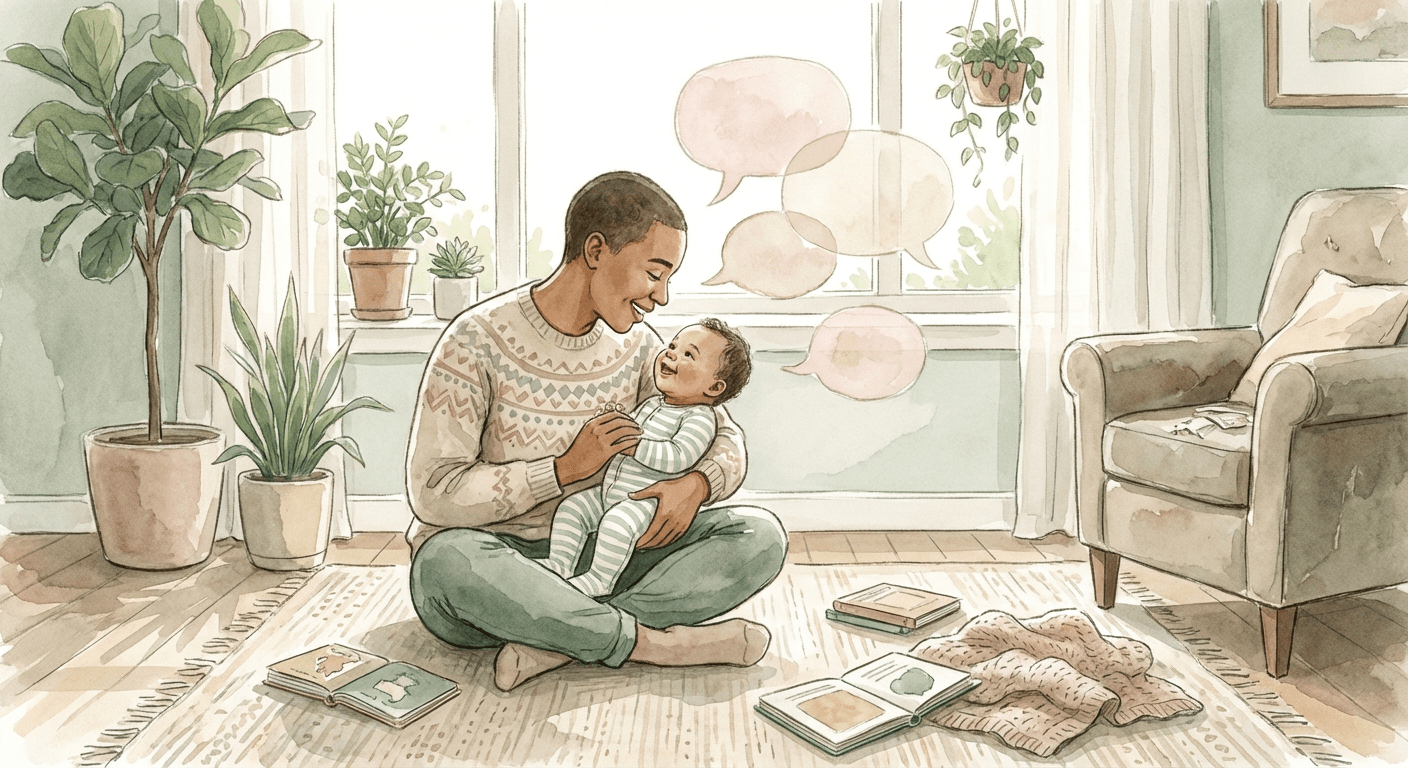
The Most Powerful Brain-Building Tool You Already Own
I'm going to let you in on a secret that completely changed my perspective as a parent: the single most important thing you can do for your baby's developing brain doesn't cost anything, doesn't require batteries, and you're probably already doing it without realizing.
It's talking to them.
I know — that sounds almost too simple. When I first read the research, I was nursing at 3am (as one does), and I actually stopped scrolling because I couldn't believe it. All those expensive developmental toys I'd been eyeing on Instagram? All those "brain-boosting" programs? The most powerful tool was my voice. The one I'd been using to narrate my trips to the fridge and provide running commentary on diaper changes.
Turns out, those rambling kitchen monologues were doing more for my baby's brain than any toy ever could. Let me show you why — and how to make the most of it without it feeling weird or forced.
What Happens in Your Baby's Brain When You Talk
Your baby's brain is under construction, and it's working at a pace that's honestly hard to fathom. In the first year alone, it doubles in size. It's forming over one million new neural connections every second, building the architecture that will support everything from language to emotional regulation to problem-solving.
And here's the part that blew my mind: one of the primary ways your baby's brain decides which connections to keep and strengthen is through the language it hears.
When you talk to your baby, you're not just making pleasant sounds. You're activating their auditory cortex, lighting up language-processing regions like Broca's area (critical for speech production) and Wernicke's area (key for comprehension), and physically strengthening the neural pathways that will eventually allow your child to understand and produce speech.
A 2023 study from the University of East Anglia, published in The Journal of Neuroscience, found something remarkable: toddlers who heard more words from nearby adults had more myelin — the insulating substance that makes communication between brain cells faster and more efficient — in their language-related brain regions. In other words, your words literally build your baby's brain infrastructure.
This isn't abstract neuroscience. It's concrete, physical, measurable brain growth. From your voice.
It's Not About How Many Words — It's About the Conversation
You may have heard of the famous "30 million word gap." In 1995, researchers Betty Hart and Todd Risley published a landmark study showing that by age 3, children from higher-income families had heard roughly 30 million more words than children from lower-income families, and that this gap predicted later academic outcomes.
That study was hugely influential — and it's been refined since. More recent research suggests the gap may be closer to 4 million words, and the income framing has been challenged. But the core insight stands: language exposure in the early years matters enormously.
Here's where it gets really interesting.
In 2018, Rachel Romeo and her colleagues at MIT published a groundbreaking study in Psychological Science that shifted the entire conversation. Using brain imaging (fMRI), they found that conversational turns — the back-and-forth exchanges between an adult and a child — were a far stronger predictor of language skills and brain activation than the raw number of words heard.
Let me say that again because it's so important: it's not about talking *at your baby. It's about talking with them.*
When you pause after saying something and wait for your baby to coo, babble, or wiggle in response — and then you respond back — that back-and-forth is pure brain-building gold. Romeo's team found that more conversational turns correlated with stronger activation in Broca's area, regardless of the family's income level.
A 2020 Stanford study confirmed this with even younger babies: when adults conversed directly with 5- to 8-month-olds (rather than just talking near them), the babies showed more brain development in areas involved in language comprehension. Your baby knows the difference between being talked to and being talked with.
Parentese: Your Secret Superpower
Okay, here's something that made me feel so much better about all those times I've talked to my baby in That Voice. You know the one — higher pitch, slower pace, big exaggerated vowels. "Hiiiii, baaaby! Look at the DOGGY!"
That voice has a name: parentese. And it's not silly. It's a scientifically validated communication tool.
Parentese is not the same as "baby talk" (the "goo goo ga ga" nonsense). Parentese uses real words and proper grammar — it's just delivered with more melody, slower tempo, and wider pitch range. And babies are absolutely captivated by it.
Researchers at the University of Washington's Institute for Learning & Brain Sciences (I-LABS) conducted a landmark 2020 study, published in the Proceedings of the National Academy of Sciences, that proved parentese isn't just cute — it's effective. When parents received coaching on using parentese more deliberately:
- They had significantly more conversational turns with their babies
- Their babies produced real words at nearly twice the frequency of the control group
- By 18 months, coached parents' children had an average vocabulary of about 100 words, compared to about 60 words in the control group
Patricia Kuhl, co-director of I-LABS, described parentese as a "social hook for the baby brain" — its high pitch and slower tempo are socially engaging and actually invite the baby to respond, creating those precious conversational turns.
So that singsongy voice you naturally slip into? It's not embarrassing. It's evolution's language-teaching strategy, and the science says to lean into it.
The Power of Serve and Return
The Harvard Center on the Developing Child has a beautiful framework for this called "serve and return." Think of it like a game of tennis:
1. Your baby serves — they coo, babble, point, make a face, or even cry 2. You return — you respond with words, eye contact, a smile, or a hug 3. The rally continues — back and forth, building the connection
Every one of these exchanges strengthens neural connections in your baby's brain. Over thousands of interactions, this serve-and-return pattern builds the brain architecture that supports communication, emotional regulation, and cognitive skills.
The magic ingredient? Responsiveness. It doesn't matter if your "return" is perfect or eloquent. What matters is that you noticed their serve and responded. That alone tells your baby's brain: This world is responsive. My signals matter. It's safe to keep communicating.
And research from MIT in 2021 by Romeo and Gabrieli showed that when families increased their conversational turns through targeted practice, children showed measurable improvements in language skills within weeks and actual cortical growth in language and social processing areas. Weeks!
7 Simple Ways to Build Your Baby's Brain With Your Voice
Ready for the practical part? Here's the good news: you don't need to set aside special "brain-building time." Every moment is an opportunity.
1. Narrate Your Day
This one felt weird to me at first. I'm buttering toast and providing a running commentary like a sports announcer: "Now I'm getting the bread out. Oh, it's the wholegrain one. Let's put it in the toaster. Pop! There it goes."
But this technique — called self-talk by speech-language pathologists — is incredibly powerful. You're giving your baby a constant stream of words in context, helping them connect language to actions and objects.
Don't worry about doing it non-stop. Even narrating a few activities a day — a diaper change, making lunch, a walk around the block — makes a real difference.
2. Be Their Sportscaster
The flip side of narrating your own actions is narrating your baby's. This is called parallel talk: "Oh, you grabbed the spoon! You're banging it on the tray. Bang, bang, bang! Now you're looking at the dog."
This helps your baby connect words to their own experiences and builds comprehension even before they can speak.
3. Use Parentese (Lean Into That Voice)
Remember — higher pitch, slower speed, exaggerated vowels, real words. "Look at the biiiig treeeee! Can you seeeee the leaves?" The research is clear: this captures your baby's attention and invites them to engage. Don't fight the instinct.
4. Pause and Wait
This is the one most people miss. After you say something, pause. Give your baby 5-10 seconds to respond — with a coo, a babble, a wiggle, a look. Then respond to whatever they give you.
These pauses create the conversational turns that Romeo's research showed are so critical. You're teaching your baby the fundamental rhythm of conversation: I talk, you talk, I talk.
5. Sing Songs and Nursery Rhymes
Research from the University of Cambridge and Trinity College Dublin, published in Nature Communications, found that babies actually learn language primarily through rhythmic patterns in their early months — and that rhythmic speech like nursery rhymes is processed as early as two months of age.
So sing. Badly, beautifully, whatever. "Twinkle Twinkle," "The Wheels on the Bus," songs you make up about changing a nappy. The rhythm and repetition are doing heavy lifting for your baby's language-processing brain.
6. Read Together
The AAP recommends shared reading from birth — and their updated 2024 guidance specifically emphasizes print books over digital ones, because physical books foster more interactive parent-child conversation.
Your newborn won't follow the plot. That's fine. What matters is the closeness, the sound of your voice, and the back-and-forth as you point at pictures and talk about what you see. Board books with simple images are perfect. But honestly, reading them your novel works too — it's your voice that matters.
7. Follow Their Lead
When your baby stares at something — the ceiling fan, a shadow on the wall, the cat — talk about it. "Oh, you see the fan! It goes round and round. Round and round!" Following their gaze and interests makes language more meaningful because it connects words to whatever has their attention in that moment.
What You Don't Need to Worry About
You don't need to talk non-stop. A few engaged conversational moments beat hours of background chatter. Babies need downtime too.
You don't need "educational" language. Talk about the laundry, the weather, how tired you are. The content matters less than the connection.
You don't need a perfect vocabulary. The benefits hold across languages, dialects, and education levels. It's the interaction pattern that builds brains, not your word choices.
Screens are not a substitute. The 2020 Stanford research showed that overheard speech (including from screens) doesn't activate babies' brains the way direct conversation does. Your baby's brain needs a real person, responding in real time.
Key Takeaways
- **Conversational turns** (back-and-forth exchanges) matter more for brain development than the total number of words your baby hears
- **Parentese** — real words spoken with higher pitch, slower tempo, and exaggerated intonation — is a scientifically proven brain-building tool, not silly baby talk
- **Serve and return** interactions physically strengthen neural connections in your baby's brain — every coo you respond to counts
- You don't need special programs or products — **narrating your day, singing, reading, and pausing to let your baby "respond"** are the most powerful tools
- The University of Washington study showed coached parents' babies had **nearly double the vocabulary** by 18 months
- **It's never too early to start** — babies process rhythmic speech patterns from as young as two months old
You're Already Doing This
If you've ever narrated a trip to the shops, sung off-key during bath time, or just looked into your baby's eyes and said "I love you" — you've been building their brain.
Your baby doesn't need apps or flashcards or expensive programs. They need your voice, your attention, and those tiny moments of back-and-forth that feel so ordinary but are doing extraordinary things inside their growing brain.
So keep talking. Keep singing. Keep pausing to let them babble back.
Because to your baby's brain, those moments are everything.
Stay in the loop
Weekly tips backed by science, delivered with love.
You might also like
Your Baby Doesn't Need Expensive Toys to Develop Well — Here's What They Need Instead
The baby toy industry is worth billions — but research shows the best brain-building tools are free. Here's what science…
Boys' Brains vs. Girls' Brains: What Neuroscience Actually Tells Us
Are boys really "wired" for trucks and girls for dolls? The science of sex differences in baby brains is way more nuance…