How Bilingual Environments Shape Your Baby's Brain Development
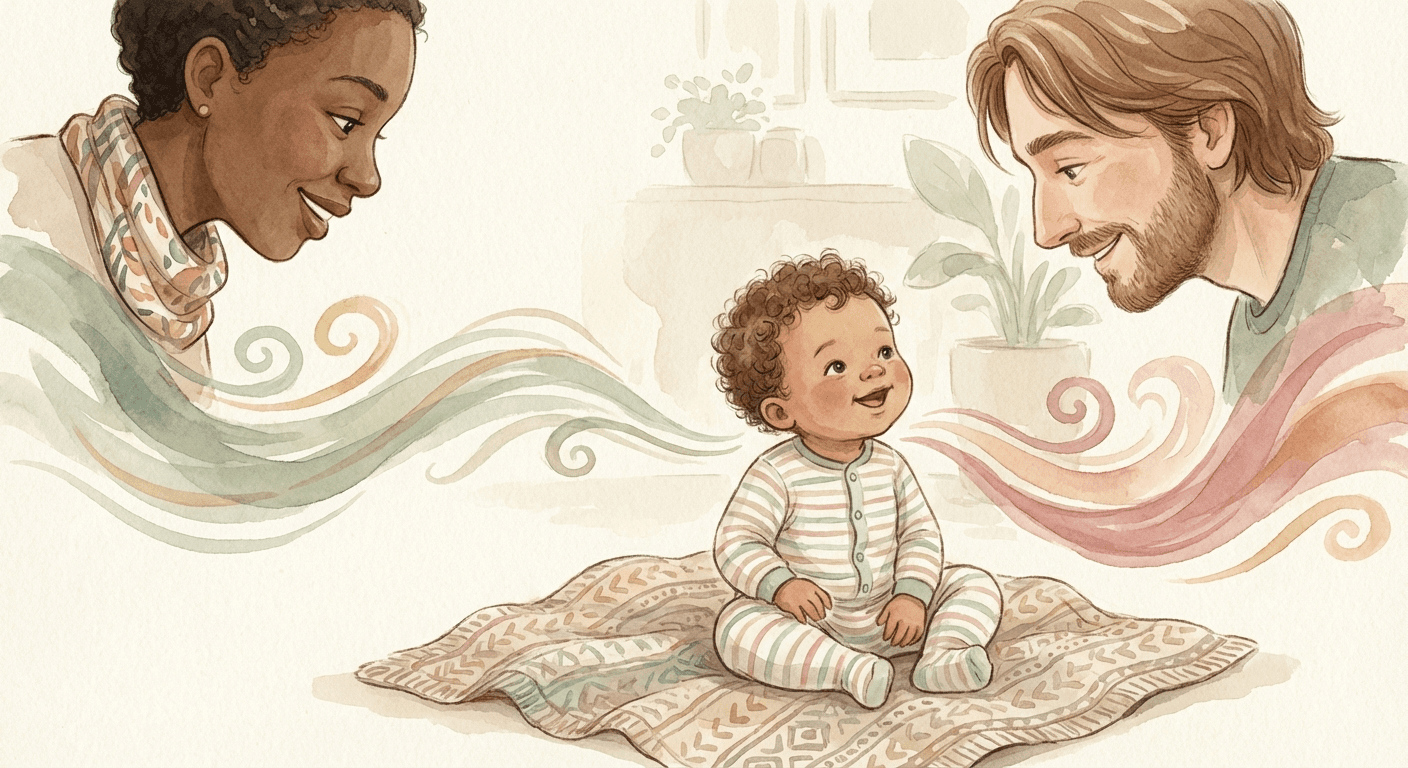
The Question That Kept Me Up at Night
When my husband and I first talked about raising our kids with two languages, I immediately fell down a rabbit hole of worry. My mother-in-law speaks Cantonese. I speak English. Would our baby be confused? Would they be late to talk? Would we somehow mess up their language development by giving them "too much" to process?
I actually lost sleep over this. And I know I'm not the only one — because the number one question I get from parents in multilingual families is some version of: "Are we hurting our baby by speaking two languages?"
So let me cut straight to the answer: No. Not even a little bit. In fact, you might be giving them one of the greatest cognitive gifts possible.
The science on bilingual brain development in babies is genuinely exciting, and once I understood it, all that guilt and worry turned into something else entirely — awe.
Your Baby's Brain Was Built for This
Here's something that blew my mind: newborns can already tell languages apart. Not just different-sounding languages like English and Mandarin — they can distinguish between rhythmically similar languages too.
Researchers have known for decades that babies are born as "citizens of the world" when it comes to language. In the first months of life, your baby can perceive the sound differences used in virtually every language on earth — about 800 different sounds called phonemes. Adults can typically perceive only about 40.
Around 10-12 months, something happens in monolingual babies: their brains start narrowing. They become specialists in the sounds of their native language and lose sensitivity to sounds they don't hear regularly. It's efficient — the brain is pruning what it doesn't need.
But here's where bilingual babies do something different. Research from the University of Washington's Institute for Learning & Brain Sciences (I-LABS) shows that bilingual infants maintain this broader sensitivity to speech sounds for longer. Their brains stay "open" to a wider range of linguistic input, which Dr. Patricia Kuhl, co-director of I-LABS, describes as keeping the window of language learning open wider.
In other words, while monolingual babies are becoming specialists, bilingual babies are becoming flexible specialists — and that flexibility has ripple effects across their entire cognitive development.
The Executive Function Advantage
This is where the research gets really interesting.
In 2016, Dr. Naja Ferjan Ramirez and Dr. Patricia Kuhl published a landmark study using magnetoencephalography (MEG) — a brain imaging technology that can pinpoint exactly where and when brain activity occurs. They looked at 11-month-old babies — too young to speak — raised in bilingual versus monolingual homes.
What they found: bilingual babies showed significantly more activity in brain regions associated with executive function, specifically the prefrontal and orbitofrontal cortex. These are the areas responsible for planning, focusing attention, switching between tasks, and managing conflicting information.
At 11 months old. Before they'd even said their first word.
Why does this happen? Think of it from your baby's perspective. Every moment of every day, a bilingual baby is doing something cognitively demanding without even realizing it. They're hearing sounds, identifying which language is being spoken, activating the right language system, and suppressing the other one. It's like a continuous workout for the brain's control center.
Dr. Ferjan Ramirez put it this way: the experience of managing two languages doesn't just shape language development — it shapes general cognitive development. The brain regions getting all that extra exercise aren't just language areas. They're the same regions we all use for problem-solving, attention, and self-control.
What the Latest Research Tells Us
The science has continued to evolve, and I want to be honest with you about what we know and what's still being figured out — because I think you deserve the full picture, not just the highlight reel.
A comprehensive meta-analysis published in 2020, which reviewed 143 separate comparisons across multiple studies, found a significant bilingual advantage in cognitive flexibility and task-switching. This means bilingual children were measurably better at shifting between different rules and tasks — a skill that matters enormously in everyday life (and in school).
The advantage in inhibitory control — the ability to resist impulses and ignore distracting information — was also present, though more variable across studies. Some research with toddlers as young as 24 months has found bilingual advantages on tasks like the Stroop test, which measures how well you can override automatic responses.
A 2023 study published in Language and Cognition added an important nuance: the degree of bilingualism matters. Children with more balanced exposure to both languages showed stronger benefits in shifting and working memory compared to those with very uneven exposure. This doesn't mean you need a perfect 50/50 split — but it does suggest that regular, meaningful use of both languages makes a difference.
Research from Georgetown University has even found structural brain differences: bilingual children may retain more grey matter in frontal and parietal regions — areas critical for attention and cognitive control — compared to monolingual peers as they grow.
The Myths That Need to Die
Okay, let's tackle the misconceptions head-on, because some of these still get repeated by well-meaning relatives, and even occasionally by healthcare providers who aren't up to date on the research.
Myth #1: "Two Languages Will Confuse Your Baby"
Reality: Babies can distinguish between their two languages from the earliest days of life. They are not confused. Full stop. The American Academy of Pediatrics (AAP), Zero to Three, and every major research institution studying this topic agrees: bilingual babies know exactly what's happening.
Myth #2: "Bilingual Children Talk Later"
Reality: Bilingual children hit language milestones — first words, two-word combinations, understanding familiar words — at the same age as monolingual children. Their vocabulary in each individual language might be smaller (which makes sense — they're splitting their time), but their total vocabulary across both languages combined is equivalent to or greater than a monolingual child's. The AAP has been clear on this: bilingualism does not cause speech or language delays.
Myth #3: "They Mix Languages Because They Can't Keep Them Straight"
Reality: Code-mixing (using words from both languages in one sentence) is completely normal and actually a sign of sophisticated language processing. Children as young as two can code-switch appropriately based on who they're talking to. When your toddler drops a Cantonese word into an English sentence, they're not confused — they're being resourceful with their full linguistic toolkit.
Myth #4: "You Should Drop the Home Language to Focus on English"
Reality: This one genuinely upsets me because it's both wrong and harmful. Zero to Three emphasizes that maintaining the home language is crucial for a child's cultural identity, family connection, and overall language development. Parents communicate best — with richer vocabulary, better grammar, and more emotional expression — in the language they're most comfortable with. Dropping your home language doesn't speed up English acquisition. It just means your child hears less rich, less nuanced language overall.
What's Actually Happening in Your Baby's Brain
Let me paint the picture of what bilingual processing looks like from the inside.
When your baby hears you speak, their brain activates language networks — areas like Broca's area (for language production) and Wernicke's area (for comprehension). In a bilingual baby, both language systems are active simultaneously, even when only one language is being spoken. The brain doesn't just switch one off; it manages both at the same time.
This constant dual activation is what researchers believe drives the executive function benefits. Your baby's brain is essentially practicing conflict management all day, every day — deciding which language system to prioritize, which signals to attend to, and which to temporarily suppress.
This is a form of neuroplasticity in action — the brain physically reorganizing itself in response to experience. Studies have shown that bilingual individuals develop stronger connections between language-related brain areas, and over time, the brain becomes more efficient at this juggling act.
An interesting finding from Goldsmiths, University of London showed that hearing infants exposed to two spoken languages from birth showed greater engagement of the right hemisphere when processing language — suggesting their brains recruit additional neural resources for the job. More of the brain working on language means more of the brain getting the cognitive workout.
Practical Tips for Raising a Bilingual Baby
So how do you actually do this in real life, when you're exhausted and barely remembering to brush your own teeth? Here's what the research says works.
1. Start From Birth (But It's Never Too Late)
The first three years are a critical window for language acquisition. Your baby's brain is primed to absorb languages right now in a way it never will be again. But if you're reading this with a two-year-old, you haven't missed the boat — not by a long shot.
A 2017 I-LABS study showed that babies from monolingual homes who received just one hour per day of play-based second language exposure over 18 weeks made significant gains in comprehension and production of the new language. One hour a day. That's entirely doable.
2. Try the OPOL Approach
One Parent, One Language is one of the most popular strategies, and research supports its effectiveness. Each parent consistently speaks a different language to the child. It helps your baby associate each language with a specific person, making it easier to keep them organized. Research suggests about 75% of children raised with a consistently followed OPOL approach develop active bilingualism.
3. Prioritize Interaction Over Passive Exposure
This is critical. Screen time in a second language doesn't build bilingualism. We know from decades of research that babies learn language through live, interactive, serve-and-return exchanges — not from hearing it on TV.
Read books together in both languages. Sing songs. Narrate your day. The magic is in the interaction, not the input.
4. Aim for Meaningful Quantity
Research suggests aiming for at least 25 hours per week of exposure to the minority language (the one less spoken in your community) to develop strong skills in both languages. That might sound like a lot, but it includes everything — conversations, storytime, songs, playdates with grandparents, even listening to you chat on the phone.
5. Build a Language Community
Seek out playgroups, cultural events, or family members who speak the minority language. Children need to see that their language has social value — that real people use it, and that it connects them to others. Video calls with grandparents absolutely count.
6. Don't Panic About Code-Mixing
When your toddler says "I want más juice," they're not confused. They're brilliant. Smile, repeat back in your designated language, and keep going.
7. Be Consistent, Not Perfect
You will slip. You will sometimes use the "wrong" language because you're tired or it's just easier. That's fine. What matters is the overall pattern of consistent, rich exposure — not rigid perfection.
Key Takeaways
- Bilingual environments do NOT confuse babies or cause speech delays — this is a myth thoroughly debunked by the AAP, Zero to Three, and decades of research
- By 11 months, bilingual babies already show increased brain activity in executive function regions, giving them a cognitive head start in attention, focus, and mental flexibility
- Your baby's total vocabulary across both languages combined is equivalent to or greater than a monolingual child's — counting only one language gives an incomplete picture
- Code-mixing (switching between languages in a sentence) is a sign of sophisticated language processing, not confusion
- Interactive exposure is what matters most — talking, reading, singing, and playing in both languages builds brains; passive screen exposure does not
- Aim for consistent, meaningful exposure to both languages — strategies like One Parent, One Language (OPOL) and building a minority-language community can help
You're Not Giving Them a Problem — You're Giving Them a Superpower
Full disclosure: there was a moment, early on, when a relative suggested we should "just stick to English" to make things easier. I felt that familiar twist of guilt. Was I making my child's life harder?
Now, knowing what I know, I see it completely differently. Every time my child hears Cantonese from their grandmother, every time they hear English from me, every time they switch effortlessly between the two — their brain is doing something extraordinary. It's building stronger neural pathways, developing better cognitive control, and forming connections to their family and culture that no single language could provide.
Zero to Three calls dual language learning "double the benefit." And honestly? It feels like even more than that.
So if you're in a multilingual family and someone — a relative, a neighbor, that one person at the playground — tells you that two languages are "too much" for a little brain to handle, you can smile and tell them: actually, it's exactly what little brains were made for.
Stay in the loop
Weekly tips backed by science, delivered with love.
You might also like
Your Baby Doesn't Need Expensive Toys to Develop Well — Here's What They Need Instead
The baby toy industry is worth billions — but research shows the best brain-building tools are free. Here's what science…
Boys' Brains vs. Girls' Brains: What Neuroscience Actually Tells Us
Are boys really "wired" for trucks and girls for dolls? The science of sex differences in baby brains is way more nuance…