Flash Cards for Babies: Helpful or Hype?
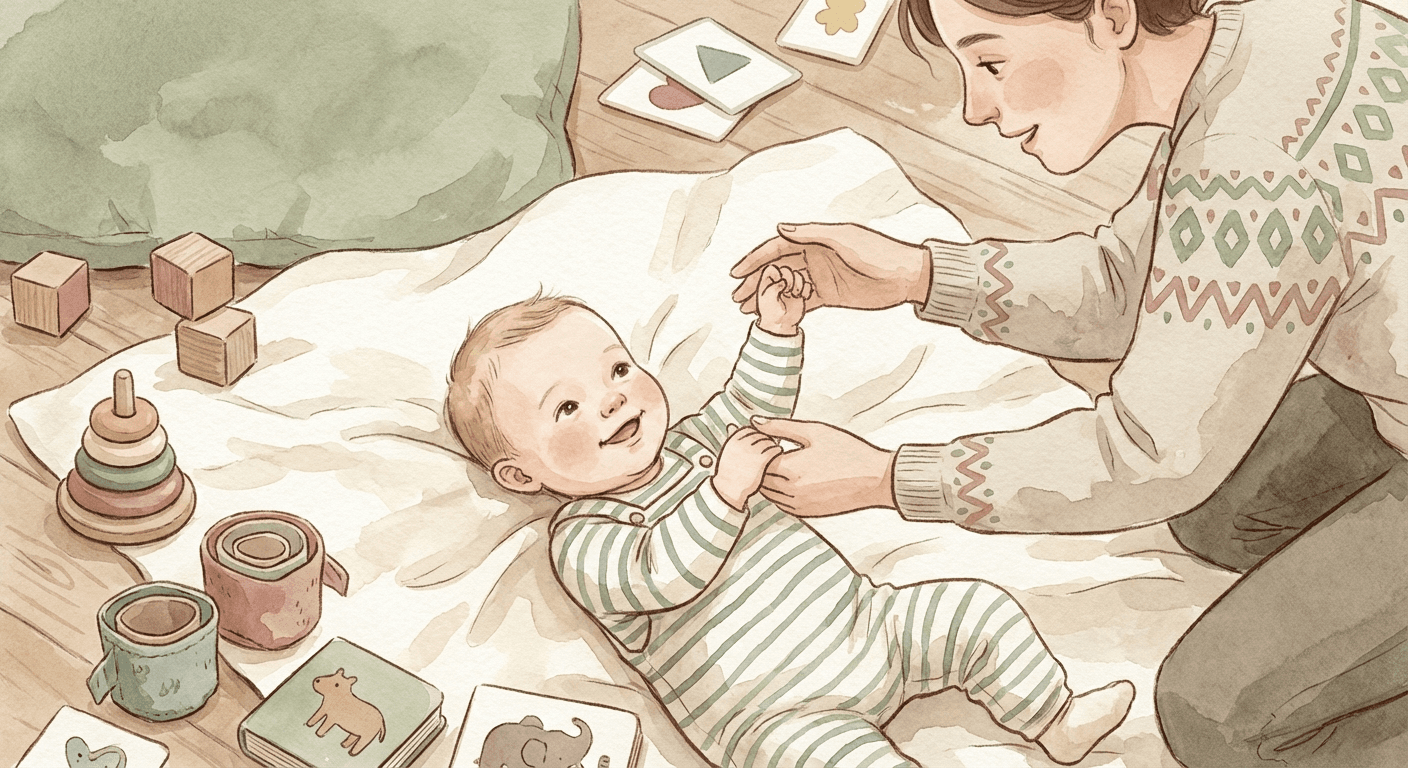
The Flash Card Aisle Is Getting Out of Control
I was in a baby store a few months ago, and I counted no fewer than twelve different flash card sets marketed to babies under one. Alphabet flash cards. Number flash cards. "Baby genius" flash cards. Mandarin flash cards for six-month-olds.
And I'll be honest — before I fell down the rabbit hole of baby brain research, I would've grabbed at least two of those sets without thinking twice. They look educational. They feel productive. And the packaging makes some pretty bold promises about giving your baby a head start.
So when I started actually reading the science? I had to sit with some uncomfortable truths. Because the story of flash cards for babies is more nuanced than the marketing suggests — and also, in a weird way, more reassuring.
The short version: most flash card use for babies is hype. But there's a small kernel of legitimate benefit — and understanding the difference matters.
Let's break it down.
The Flash Card Industry and Where It Came From
The idea of using flash cards with babies isn't new. It traces back largely to Glenn Doman, a physical therapist who founded the Institutes for the Achievement of Human Potential in the 1950s. His book How to Teach Your Baby to Read (1964) popularized the idea that babies could learn to read words by seeing them flashed rapidly on cards — what he called "Bits of Intelligence."
Doman's method was intense: parents were encouraged to show flash cards multiple times a day, in quick sessions, starting from infancy. The underlying theory was that babies' brains are at peak receptivity, and that rapid visual stimulation would forge powerful neural pathways.
It sounds compelling. But here's the problem: there are no systematic reviews or controlled clinical trials evaluating the Doman method's effects on typically developing children. The American Academy of Pediatrics went further, specifically criticizing the related Doman-Delacato "patterning" method as being based on an "outmoded and oversimplified theory of brain development."
Despite the lack of rigorous evidence, the Doman approach inspired an entire industry. Today, flash cards for babies are a multi-million dollar market — from Shichida method cards to "right brain education" sets, to the colourful vocabulary builders you see at every baby shop.
But what does the actual science say?
What the Research Tells Us
The "Einstein Never Used Flash Cards" Problem
In 2003, developmental psychologists Kathy Hirsh-Pasek (Temple University) and Roberta Golinkoff (University of Delaware) published a book that sent shockwaves through the early education world: Einstein Never Used Flash Cards: How Our Children Really Learn — and Why They Need to Play More and Memorize Less.
Drawing on decades of research, they argued that:
- Rote memorization through flash cards doesn't lead to better long-term retention in young children
- Children drilled with academic tools like flash cards tend to display less creativity and less enthusiasm for learning than their peers
- Play-based learning is not just "good enough" — it's superior to drilling academics, across multiple measures of cognitive and social development
Their work didn't say flash cards are harmful, exactly. But it made a powerful case that the time parents spend flashing cards at their babies could be far better spent doing something else — something the baby's brain is actually wired for.
When I first read about their research, I remember thinking: wait, so all those Instagram parents with the perfectly curated flash card stations might actually be... optimizing for the wrong thing?
Harvard Says: Play Builds Brains
The Harvard Center on the Developing Child has been studying what actually builds healthy brain architecture in young children for decades. Their conclusion is unambiguous: responsive, serve-and-return interactions are the single most important factor in early brain development.
Serve and return is beautifully simple. Your baby "serves" — a coo, a pointed finger, a babble. You "return" — responding with words, eye contact, engagement. This back-and-forth strengthens neural connections in real time.
Flash cards, by their nature, are a one-way delivery system. You show. The baby looks. There's no back-and-forth. No contingent response. No opportunity for the baby to lead the interaction.
Harvard's recommendation? Brain-building games like peek-a-boo, imitation games, and hiding games — all of which involve the dynamic, two-way interaction that flash cards can't provide. Notably, rote memorization doesn't appear anywhere in their guidance on infant learning.
The Cambridge Meta-Analysis (2022)
A major systematic review published in 2022 by researchers at the University of Cambridge examined 39 studies involving nearly 3,900 children aged 1 to 8. They compared guided play (where adults gently steer playful activities toward learning goals) with direct instruction (adult-led, structured teaching).
The findings were striking:
- Guided play was more effective than direct instruction for early math skills, shape knowledge, and task switching
- Guided play showed a greater positive effect on spatial vocabulary compared to free play
- There was no area where direct instruction outperformed guided play
This matters for the flash card conversation because flash cards are essentially a form of direct instruction — adult-led, structured, drill-based. And the evidence increasingly shows that this approach is less effective than simply playing with your child in an intentional way.
Zero to Three's Position
Zero to Three, one of the most respected early childhood organizations in the world, is clear: play is the primary mode of learning for infants and toddlers. They describe play as the "work" of babies and toddlers, through which children learn about the world, try out new skills, and explore their imagination.
Their guidance emphasizes following the child's lead, providing responsive interaction, and letting exploration happen naturally — not through structured drills or memorization exercises.
The One Exception: High-Contrast Cards for Newborns
Now, here's where it gets nuanced — because there is one type of "flash card" that has legitimate developmental value.
High-contrast black and white cards for newborns (0-3 months) genuinely support visual development. And this isn't hype — it's basic visual science.
At birth, babies see the world primarily in shades of black, white, and grey. Their vision is blurry, and they can only focus on objects about 8-15 inches from their face. High-contrast patterns provide the strongest visual signal to their developing visual system.
Showing a newborn simple black and white patterns can:
- Stimulate the retina and strengthen visual pathways
- Help develop focus and attention — babies are naturally drawn to bold contrasts
- Support visual tracking — slowly moving a card encourages eye-movement coordination
- Lay groundwork for visual discrimination — the ability to distinguish shapes and patterns
But here's the key distinction: these aren't really "flash cards" in the way the industry means. You're not drilling information. You're not expecting your baby to memorize anything. You're simply giving their developing visual system something appropriately stimulating to look at — like a workout for brand-new eyes.
I used high-contrast cards with my baby during tummy time, and honestly, the way those little eyes locked onto the patterns was pretty magical. But I wasn't teaching content. I was supporting a visual system that was still booting up.
Once your baby's vision matures (around 3-4 months, when they start seeing colours well), the specific benefit of high-contrast cards largely fades. At that point, looking at real objects, faces, and the natural world is far richer visual input.
Why Flash Cards Feel So Right (Even When They're Not)
So if the science is this clear, why are flash cards still everywhere? I think there are a few reasons — and they're worth understanding because they're really about parenting psychology, not about cards.
1. They Feel Productive
Parenting a baby involves a lot of ambiguity. Am I doing enough? Is my baby learning? Flash cards give you something measurable and visible. You can count the cards. You can track the words. It feels like progress — even when the baby's brain isn't processing it the way we imagine.
2. The Marketing Is Powerful
The baby education industry knows exactly how to press parental anxiety buttons. Words like "brain-boosting," "cognitive advantage," and "head start" are carefully chosen. When every other parent on Instagram seems to be doing flash cards at 6 months, the pressure to keep up is real.
3. We Underestimate Play
This is the big one. We live in a culture that values structured, visible productivity. Play looks like... nothing. A baby stacking and knocking over cups doesn't look like learning. A toddler pouring water back and forth doesn't look like brain development.
But it is. It profoundly is.
As Hirsh-Pasek and Golinkoff write, we have a tendency to undervalue the very activities that research consistently shows are most beneficial. Play doesn't feel rigorous enough. Flash cards feel like we're doing something. But feeling productive and being effective aren't the same thing.
What Actually Builds Your Baby's Brain (Instead of Flash Cards)
Here's the genuinely good news: the things that work best are free, simple, and you're probably already doing many of them.
1. Narrate Everything
Talk to your baby constantly. Describe the breakfast you're making, the dog you pass on the walk, the texture of their towel. The quantity and quality of words a baby hears directly predicts vocabulary size and later academic success. Your running commentary is more powerful than any flash card deck.
2. Read Together
Shared reading — even just 10 minutes a day — has measurable effects on language development. The AAP recommends shared reading from birth. Let your baby grab the book, chew the corners, flip back to the same page. The interaction around the book is what matters.
3. Follow Their Lead
When your baby stares at a leaf, stare at the leaf with them. Name it. Describe it. Wonder about it. Child-led exploration supported by a responsive adult is the gold standard for early learning, according to multiple research frameworks. It builds curiosity, sustained attention, and intrinsic motivation.
4. Play Simple Games
Peek-a-boo teaches object permanence and anticipation. Copying games build imitation skills and social cognition. Stacking blocks and knocking them down teaches cause and effect. These aren't "just" games — they're precisely what the developing brain needs.
5. Sing and Use Nursery Rhymes
Musical patterns help babies recognize speech rhythms and sounds. Nursery rhymes are particularly powerful because their repetitive structure helps the brain predict and process language patterns. Your singing voice doesn't need to be good. It just needs to be yours.
6. Provide Sensory Exploration
Water play. Sand. Grass between tiny fingers. Safe kitchen items to bang together. The more multi-sensory input your baby processes, the more neural connections form. When your baby squishes avocado into the high chair tray, they're running a science experiment. Let them.
7. Just... Be Present and Responsive
The single most powerful brain-building tool isn't a product. It's you, paying attention and responding. When your baby babbles and you babble back. When your toddler points and you name the thing. When they cry and you comfort them. Every one of these moments strengthens neural architecture in ways no flash card can.
Key Takeaways
- Most flash card use for babies is not supported by evidence — research shows play-based learning is more effective than rote memorization for young children
- The Glenn Doman flash card method has no controlled clinical trials supporting its effectiveness in typically developing children
- A 2022 Cambridge meta-analysis of nearly 3,900 children found guided play outperformed direct instruction in math, shapes, and cognitive flexibility
- High-contrast black and white cards for newborns (0-3 months) are a legitimate exception — they support visual development, not memorization
- Harvard, Zero to Three, and the AAP all emphasize responsive, play-based interaction as the foundation of healthy brain development
- The most powerful brain-building activities are free: talking, reading, singing, playing, and responding to your baby
The Bottom Line: You're Already Doing the Right Things
Look, if you've been using flash cards with your baby and your baby enjoys it — you haven't done anything wrong. A short, playful flash card session where you're making eye contact, using silly voices, and following your baby's cues is really more of an interactive game than a drill. And that's fine.
But if you've been stressing about not doing flash cards? If you've felt guilty scrolling past those perfect Instagram setups? If you've wondered whether you're falling behind because you're "just" playing with your baby?
Stop. You're not behind. You're exactly where the science says you should be.
The research is remarkably consistent on this: babies learn best through responsive, multi-sensory, play-based interactions with the people who love them. Not through cards. Not through drills. Not through products.
The fact that your baby would rather play peek-a-boo than look at alphabet cards isn't a sign that they're not ready to learn. It's a sign that their brain knows exactly what it needs.
Trust that. Trust them. And trust yourself — because the most important "educational tool" in your baby's life has been there all along.
It's you.
Stay in the loop
Weekly tips backed by science, delivered with love.
You might also like
Your Baby Doesn't Need Expensive Toys to Develop Well — Here's What They Need Instead
The baby toy industry is worth billions — but research shows the best brain-building tools are free. Here's what science…
Boys' Brains vs. Girls' Brains: What Neuroscience Actually Tells Us
Are boys really "wired" for trucks and girls for dolls? The science of sex differences in baby brains is way more nuance…