5 Daily Routines That Secretly Build Your Toddler's Brain
The Brain-Building Moments You're Already Nailing
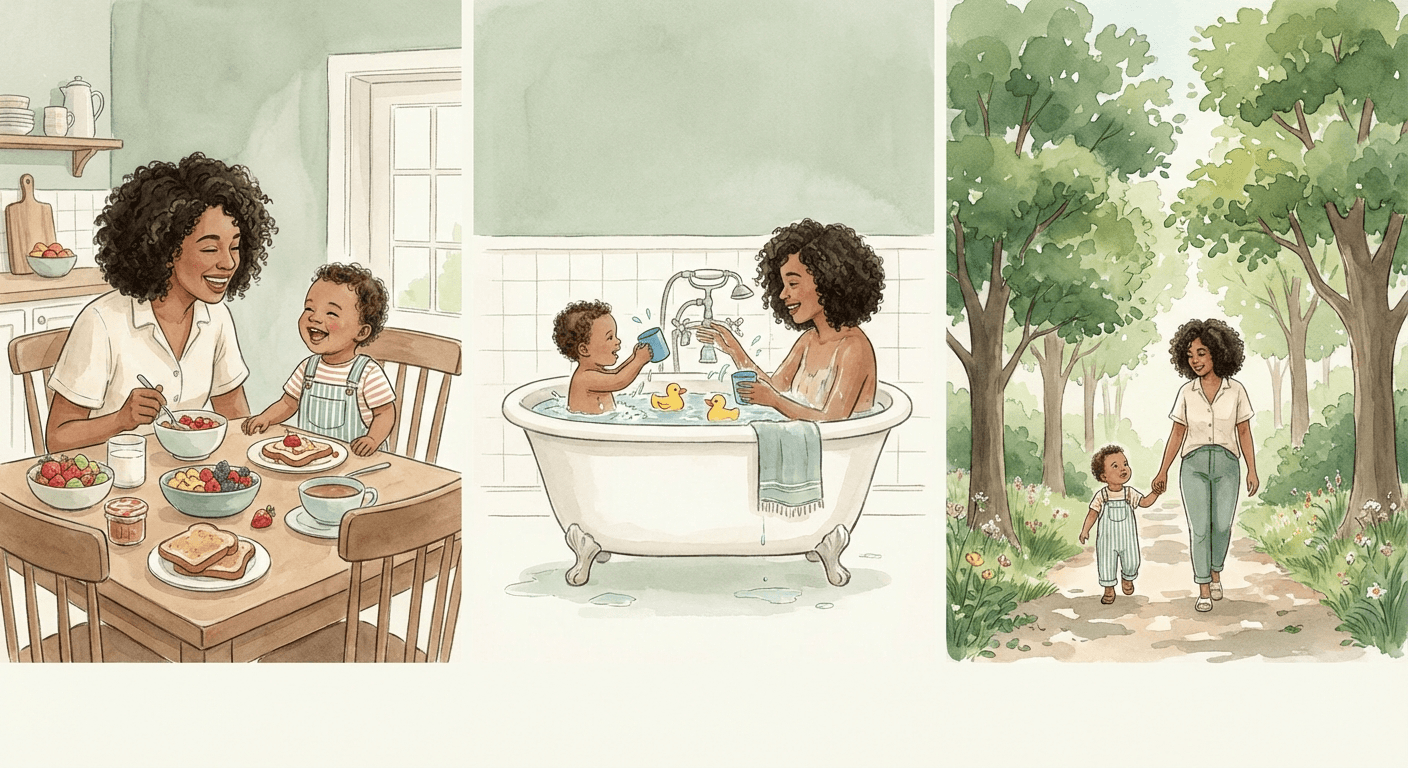
I used to feel guilty about not doing enough "brain development activities" with my toddler. Sensory bins with color-sorted rice? Curated Montessori shelves? We just had breakfast and went for a walk.
Then I read the research. And honestly? I wanted to cry with relief.
Because neuroscience tells us: the most powerful brain-building moments in your toddler's day aren't the special activities. They're the ordinary ones. The breakfast. The walk. The bath.
The Harvard Center on the Developing Child puts it simply: a young child's brain forms more than one million new neural connections every second in the early years. And what drives that explosive growth isn't expensive toys or structured lessons — it's responsive, everyday interactions with the people who love them.
Let's look at five routines you're probably already doing that are secretly building your toddler's brain.
1. Mealtimes: Your Toddler's First Classroom
Mealtime with a toddler often feels less like a "learning opportunity" and more like a food fight you didn't sign up for. But underneath the thrown peas: your child's brain is on fire (in the good way).
Research from Harvard's Graduate School of Education found that mealtime conversations can expose children to more rare and complex vocabulary than even reading aloud to them. When you narrate what you're eating, describe flavors, or talk about your day, you're flooding your toddler's brain with new words in meaningful context.
But it goes beyond language. When your toddler picks up a blueberry, they're refining fine motor skills. When they pour milk and watch it spill, that's cause and effect. When they notice the small cup fills faster than the big one — early math, without anyone calling it a lesson.
And the social-emotional learning happening at the table is enormous. Sitting together, taking turns, sharing food — these build empathy, cooperation, and self-regulation. Research in Child Development found that children who regularly participated in family mealtimes showed stronger social skills and emotional regulation.
Make It Count - **Narrate everything.** "This avocado is so squishy! Can you feel how soft it is?" You're building vocabulary with every sentence. - **Let them self-feed.** Yes, it's messy. But every fumbled spoonful is strengthening hand-eye coordination and building neural pathways. - **Put screens away.** The brain-building magic happens through face-to-face interaction. The back-and-forth — what researchers call "serve and return" — is where the real wiring happens. - **Don't stress about manners yet.** At this age, exploration matters more than etiquette. Let them squish, smell, and examine their food. It's sensory learning in action.
2. Bath Time: A Neuroscience Lab in Your Bathroom
Bath time might be my favorite secret brain-builder, because it looks like pure fun — and it is — but the developmental work happening is extraordinary.
Water play activates multiple senses simultaneously: touch (warm water, slippery soap), sight (bubbles floating, water pouring), sound (splashing, dripping), and sometimes even smell (lavender wash, anyone?). When the brain processes information from multiple senses at once, it builds and strengthens neural connections far more effectively than single-sense activities. During the first three years, the brain exhibits remarkable neuroplasticity, and sensory-rich environments like bath time take full advantage of this window.
Your toddler pouring water from a cup into a funnel? That's problem-solving and early physics. Watching objects float or sink? Scientific thinking. Squeezing a sponge? Cause and effect, plus fine motor development.
And then there's the language. "Where's your belly button?" "Can you splash with your feet?" "Look, the duck is floating!" Every one of these is a serve-and-return exchange — and the Harvard Center on the Developing Child identifies these as the single most important factor in healthy brain architecture.
Make It Count - **Provide pouring toys.** Cups, funnels, colanders — simple containers teach volume, gravity, and cause-and-effect more effectively than any app. - **Play sink or float.** Grab random bath-safe objects and let your toddler predict and test. You're building hypothesis-testing skills. - **Name body parts.** "Let's wash your elbows! Where are your toes?" This builds body awareness and vocabulary simultaneously. - **Follow their lead.** If they're fascinated by pouring water back and forth, let them. Repetition is how the brain strengthens new neural pathways.
3. Getting Dressed: An Executive Function Boot Camp
Getting my toddler dressed used to make me want to scream into a pillow. The negotiations. The inside-out shirts. The rain boots in July.
But getting dressed is actually one of the most cognitively demanding tasks in your toddler's day.
Think about what it requires: sequencing (underwear before pants, socks before shoes), planning (which arm goes where), problem-solving (the shirt is inside out — now what?), working memory (remembering the steps), and impulse control (staying focused when they'd rather play).
These are all components of executive function — what the Harvard Center on the Developing Child calls "the brain's air traffic control system." It's one of the strongest predictors of school readiness, academic success, and lifelong well-being.
Executive function isn't something you teach with worksheets. It develops through practice. Every time your toddler tries to pull on their own pants, gets frustrated, tries again, and succeeds — they're strengthening the prefrontal cortex. That region is under massive construction during the toddler years, and every small win lays another neural brick.
Make It Count - **Offer limited choices.** "Do you want the red shirt or the blue shirt?" Decision-making builds executive function, and two options prevent overwhelm. - **Break it down.** "First, let's find your shirt. Now put your arm through here." You're modeling sequential thinking. - **Let them struggle (a little).** The urge to jump in is strong, but productive struggle is where the brain growth happens. Step in before frustration boils over, but give them a chance first. - **Build in extra time.** Rushing defeats the purpose. When possible, let the getting-dressed routine take as long as it takes. Their brain is working overtime.
4. The Daily Walk: Nature's Brain Development Program
You don't need a nature preserve or a hiking trail. A walk around the block is a developmental goldmine for a toddler's brain.
Research published in Frontiers in Education found that children who spent regular time outdoors — even in ordinary neighborhood settings — showed improved executive function skills, including better working memory, stronger impulse control, and greater cognitive flexibility. One study found that preschoolers performed better on attention tasks after a nature walk compared to an urban walk, suggesting that natural elements specifically enhance cognitive restoration.
Why? The outdoor environment is an unpredictable sensory buffet. A bird calling. Leaves crunching. A puddle catching light. Unlike screens or controlled indoor spaces, nature constantly presents new stimuli that challenge the brain to process, categorize, and respond — exactly what builds strong neural networks.
The walk itself also demands serious motor planning. Navigating uneven sidewalks, stepping over cracks, climbing a curb — these require the brain to coordinate sensory input with motor output in real time, strengthening connections between the cerebellum and the prefrontal cortex.
And of course, there's the conversation. "Look at that dog!" "Do you hear that bird?" Every pause to examine a leaf is a serve-and-return interaction building language and cognitive skills. Outdoor time also reduces cortisol — the stress hormone — meaning the brain can devote more resources to learning rather than managing anxiety.
Make It Count - **Go at their pace.** A toddler walk is not an exercise walk. If they want to spend five minutes examining a dandelion, that's the whole point. - **Narrate what you see.** "The leaves are turning yellow. Can you feel how crunchy they are?" Outdoor narration builds vocabulary in context. - **Let them lead.** Following your toddler's curiosity — rather than directing it — supports autonomy and intrinsic motivation, both linked to better learning outcomes. - **Make it daily.** Consistency matters. Even 15-20 minutes of outdoor time daily provides measurable cognitive benefits.
5. The Bedtime Routine: Where Memories Get Built
I saved this one for last because it might be the most powerful — and the most surprising.
You probably already know that sleep is important for your toddler. But do you know why? It's not just rest. Sleep is when the brain does its most critical construction work.
During deep sleep (slow-wave sleep), your toddler's brain is consolidating memories — taking the day's experiences and converting short-term memories into long-term ones. Those new words from breakfast? The problem they solved during bath time? During sleep, the brain replays and strengthens those neural connections, making them permanent.
Research shows that children's brains are particularly efficient at memory consolidation during sleep — even more so than adults'. Toddlers experience a higher proportion of slow-wave sleep, the phase when newly learned information is transferred to the prefrontal cortex for long-term storage.
And the bedtime routine itself? It's doing double duty. A predictable sequence — bath, pajamas, teeth, books, bed — teaches sequencing and anticipation, and signals the brain to begin winding down. A global study of over 10,000 children found that consistent bedtime routines were associated with earlier bedtimes, faster sleep onset, fewer nighttime awakenings, and longer total sleep.
If you read to your toddler at bedtime — even for just 10 minutes — you're delivering a triple hit: language exposure, emotional bonding, and cognitive stimulation, all right before the brain enters its memory-consolidation phase. When I learned that the bedtime routine is essentially loading up the brain with material and then pressing "save" — it completely changed how I thought about those exhausting evenings.
Make It Count - **Keep it consistent.** Same steps, same order, roughly the same time every night. Predictability is the point. - **Include a book (or three).** Reading before sleep maximizes the brain's ability to consolidate new vocabulary and concepts overnight. - **Talk about the day.** "What was your favorite part of today?" Even if they can only answer with one word, you're helping them practice memory recall. - **Protect sleep duration.** The AAP recommends 11-14 hours of total sleep per day for toddlers ages 1-2. Prioritize it — the brain's construction crew works the night shift.
The Thread That Ties It All Together
If you've noticed a theme, you're right. It's serve and return.
Every one of these brain-building moments depends on the same thing: a responsive adult paying attention and interacting with their child. It's not the bath that builds the brain — it's the conversation during the bath. It's not the walk — it's pausing to look at what your toddler points to.
Zero to Three calls these "everyday moments" — and they argue these ordinary interactions are where the real magic happens. If you fed your toddler this morning, talked about their socks, went outside, splashed in the bath, and read a book before bed — you just ran a full brain-development program. No special equipment. Just you, showing up.
Key Takeaways
- Your toddler's brain forms more than one million new neural connections every second — and everyday routines are a primary driver of that growth
- Mealtimes build language, fine motor skills, and social-emotional development through rich conversation and sensory exploration
- Bath time is a multi-sensory brain-building experience that strengthens neural pathways through water play, language, and cause-and-effect learning
- Getting dressed exercises executive function — sequencing, planning, problem-solving, and impulse control — which is one of the strongest predictors of school readiness
- Daily walks (even short ones) improve attention, reduce stress hormones, and build motor planning skills through unpredictable sensory input
- The bedtime routine loads the brain with learning and then triggers memory consolidation during sleep — making it one of the most powerful brain-building moments of the day
You're Already Doing This
The bar isn't as high as Instagram makes it look.
You don't need a Montessori classroom or special brain-building toys. The science is clear — it's the everyday moments that matter most. The breakfast chats. The slow walks. The bathtime giggles. The bedtime stories.
Those aren't filler between the "real" developmental activities. Those are the real developmental activities.
So tonight, when you're reading Goodnight Moon for the four-hundredth time, know this: you're not just getting through the day. You're building a brain. One ordinary routine at a time.
Stay in the loop
Weekly tips backed by science, delivered with love.
You might also like
Your Baby Doesn't Need Expensive Toys to Develop Well — Here's What They Need Instead
The baby toy industry is worth billions — but research shows the best brain-building tools are free. Here's what science…
Boys' Brains vs. Girls' Brains: What Neuroscience Actually Tells Us
Are boys really "wired" for trucks and girls for dolls? The science of sex differences in baby brains is way more nuance…