10 Simple Ways to Boost Your Newborn's Brain Development Every Day

You're Already Doing More Than You Think
I remember coming home from the hospital with my daughter and feeling completely overwhelmed. Not just by the sleep deprivation (though, wow), but by this crushing sense that I should be doing something to help her brain develop. I'd been reading about how the first three years are this incredible window for brain growth, and suddenly every waking moment felt like a test I hadn't studied for.
Here's what I wish someone had told me on that first terrifying Tuesday home: you don't need a plan, a curriculum, or a single expensive toy. The most powerful brain-building activities are the things you're probably already doing — holding your baby, talking to them, responding when they cry.
Your newborn's brain is forming more than one million new neural connections every single second right now. And the fuel for all that incredible growth? It's you. Your voice, your touch, your presence.
Let me walk you through ten simple, science-backed ways to support that development — no flash cards required.
The Science in 60 Seconds
Before we dive into the activities, here's the quick version of what's happening in your baby's brain:
At birth, your baby's brain is about 25% of its adult size. By age three, it'll reach roughly 80%. That's an extraordinary amount of growth happening in a very short window.
During this period, your baby's brain is building its architecture — the foundation that everything else will be built on. According to the Harvard Center on the Developing Child, this architecture is shaped by the interaction between genes and experiences, especially in the earliest years.
The key ingredient? Relationships. Warm, responsive, back-and-forth interactions between you and your baby literally wire their brain. It's not about stimulation for stimulation's sake — it's about connection.
Now, let's get into the ten things you can do every single day.
1. Hold Them Skin-to-Skin
This one is at the top of the list for a reason. Skin-to-skin contact (sometimes called kangaroo care) is one of the most powerful things you can do for your newborn's brain.
A Stanford University study found that premature babies who received just 20 extra minutes per day of skin-to-skin contact showed a 10-point increase on a standardized cognitive development scale. And a longitudinal study following babies for a decade found that those who received consistent skin-to-skin contact in their first weeks showed enhanced cognitive development and executive function even at age 10.
But it's not just for preemies. Research shows that skin-to-skin contact with full-term babies stimulates the left frontal area of the brain — the region linked to higher-order cognitive and emotional skills — while increasing oxytocin and decreasing stress hormones in both you and your baby.
How to do it: Hold your diapered baby against your bare chest. That's it. Do it while resting on the couch, during feeds, or just because. Even 15-20 minutes a day makes a difference.
2. Talk to Them — About Everything
I used to feel ridiculous narrating my trip to the kitchen. "Okay, now Mama's opening the fridge. Oh look, there's the milk. Let's pour some milk." My partner definitely gave me some looks. But the science is clear: your voice is your baby's favorite sound, and hearing language — even before they understand a word — builds critical neural pathways.
Research from Zero to Three shows that babies who are regularly spoken to develop stronger language skills and a richer vocabulary by age two. The AAP recommends talking to your baby from birth, using a warm, varied tone.
How to do it: Narrate your day. Describe what you're doing, what you see, what you're feeling. Talk during diaper changes, meals, and walks. Don't worry about sounding silly — your baby thinks you're fascinating.
3. Make Eye Contact (Lots of It)
Newborns can focus best on objects about 8-12 inches away — conveniently, about the distance between your face and theirs during feeding. They're hardwired to seek out faces, and when they lock eyes with you, something magical happens neurologically.
Eye contact activates areas of the brain involved in social cognition and emotional processing. It's one of the earliest forms of "serve and return" — your baby looks at you (serve), you look back and smile (return), and a neural connection gets strengthened.
How to do it: During feeds, hold your baby so you're face-to-face. Make eye contact, smile, raise your eyebrows, make gentle expressions. Let them study your face — they're learning more than you realize.
4. Respond to Their Cries
I know, I know — this one sounds obvious. But I include it because there's still a persistent myth that responding to every cry will "spoil" a baby. The science says the opposite.
When you respond to your newborn's cries consistently, you're teaching their brain that the world is safe and predictable. This builds what researchers call secure attachment, which is the foundation for healthy emotional development. The Harvard Center on the Developing Child emphasizes that responsive caregiving protects a baby's brain from the damaging effects of toxic stress.
A well-regulated stress response system — built through thousands of moments where you showed up when they needed you — sets your child up for better emotional regulation, social skills, and even academic performance later on.
How to do it: When your baby cries, respond. Pick them up, soothe them, try to figure out what they need. You literally cannot spoil a newborn. Every response is a deposit in their brain-building bank.
5. Read Aloud (Yes, Already)
The AAP recommends reading to babies from birth. Not because your two-week-old is going to follow the plot of Goodnight Moon, but because hearing the rhythm, cadence, and patterns of language activates brain areas involved in language comprehension, memory, and attention.
Studies show that babies who are regularly read to are exposed to significantly more words than those who aren't, which contributes to stronger language abilities by age two. Plus, the closeness of being held while hearing your voice combines physical comfort with cognitive stimulation — a brain-building two-for-one.
How to do it: Pick up any book — board books, picture books, even whatever you're reading. Hold your baby close and read aloud. Point at pictures. Use different voices. Make it part of your daily rhythm, like before naps or bedtime.
6. Try Gentle Infant Massage
Touch is your newborn's most developed sense, and infant massage is a beautiful way to use it for brain development. The AAP recognizes infant massage as an evidence-based practice with a calming, organizing effect on the nervous system.
Research published in the Journal of Developmental & Behavioral Pediatrics found that massage can accelerate the maturation of brain activity and visual function in infants. It also reduces cortisol (the stress hormone), which creates optimal conditions for neural growth.
How to do it: The AAP suggests starting after your baby is 10-14 days old. Use firm but gentle strokes on their legs, arms, back, and tummy. Follow your baby's lead — if they seem uncomfortable, take a break. Even five minutes a day can be beneficial.
7. Sing to Them
I cannot carry a tune to save my life. Like, genuinely terrible. But my daughter didn't care — and neither does yours. Singing combines language, rhythm, melody, and emotional connection in a way that lights up multiple brain regions simultaneously.
Research shows that musical experiences in infancy support the development of auditory processing pathways, which are closely linked to language development. Singing is also a natural form of that all-important "serve and return" — you sing, your baby reacts, you adjust your tempo or volume in response.
How to do it: Sing anything. Lullabies, pop songs, nursery rhymes, made-up songs about diaper changes. Repeat favorites — babies learn through repetition, and they love hearing the same songs over and over. (Your tolerance for "Twinkle Twinkle" will be tested. Stay strong.)
8. Do Tummy Time
Tummy time isn't just about building neck muscles — it's a full-on brain workout. When your baby is on their tummy, they're developing spatial awareness, body coordination, and visual tracking skills, all of which require serious neural processing.
Every wiggle, every attempt to lift their head, every frustrated little grunt is their brain building connections related to motor planning and sensory integration.
How to do it: Start with short sessions — even 1-2 minutes at a time — a few times a day, gradually building up to about 15 minutes total. Lie on the floor face-to-face with your baby to make it more engaging. Use a rolled towel under their chest if they need extra support. If they hate it (many do at first), that's normal — keep sessions short and positive.
9. Explore Sensory Experiences Together
Your newborn is experiencing everything for the first time — the feel of a breeze, the sound of rain, the texture of a soft blanket. Each new sensory experience helps their brain form and strengthen synaptic connections.
How to do it: - Touch: Let them feel different textures — a smooth blanket, a terry cloth, your skin. Gently stroke their hands and feet. - Sight: Show them high-contrast black and white images (newborns see these best). Hold objects about 12 inches from their face and slowly move them side to side. - Sound: Introduce gentle variety — soft music, nature sounds, the rhythm of your footsteps. Your voice remains the most important sound in their world. - Outdoors: Take them outside! The natural world is a sensory wonderland — sunlight, birdsong, wind on their skin. Even a five-minute porch sit counts.
10. Just Be Present
This last one might be the most important — and the hardest in our phone-addicted world. Simply being present and attentive with your baby is brain-building in itself.
The Harvard Center on the Developing Child's research consistently shows that the quality of interactions matters more than quantity of stimulation. You don't need to be "on" every second. But those moments when you put the phone down, look your baby in the eyes, and just be there with them? That's the good stuff. That's when the deepest neural connections form.
Full disclosure: I am not perfect at this. Some days my phone feels permanently attached to my hand, and the guilt creeps in. But I've learned that it's about the overall pattern, not perfection. A parent who is generally present and responsive is giving their baby exactly what their brain needs.
Key Takeaways
- Your newborn's brain forms over **1 million neural connections per second** — and your interactions fuel that growth
- **Skin-to-skin contact** is one of the most powerful brain-builders, with benefits lasting up to a decade
- **Talking, singing, and reading** to your newborn from day one builds critical language pathways — even before they understand words
- **Responding to cries** doesn't spoil your baby — it builds secure attachment and a healthy stress response system
- You don't need expensive toys or programs — **connection, touch, and presence** are the most effective tools for brain development
- **Consistency over perfection** — what matters is your overall pattern of warmth and responsiveness, not getting every moment right
You're Their Whole World (And That's Enough)
Here's the thing that took me way too long to internalize: the most sophisticated brain-building technology on the planet is you.
Not an app. Not a subscription box. Not a $200 "developmental" toy. You — your voice, your warmth, your willingness to show up and respond.
Every time you hold your baby close, narrate your grocery list, sing off-key in the shower while they listen from their bouncer, or simply sit quietly together watching the light change — you're building their brain.
The research from Harvard, the AAP, and Zero to Three all point to the same conclusion: babies don't need more stuff. They need more you.
So take a breath. You're doing this. And all those small, ordinary, everyday moments? They're everything.
Stay in the loop
Weekly tips backed by science, delivered with love.
You might also like
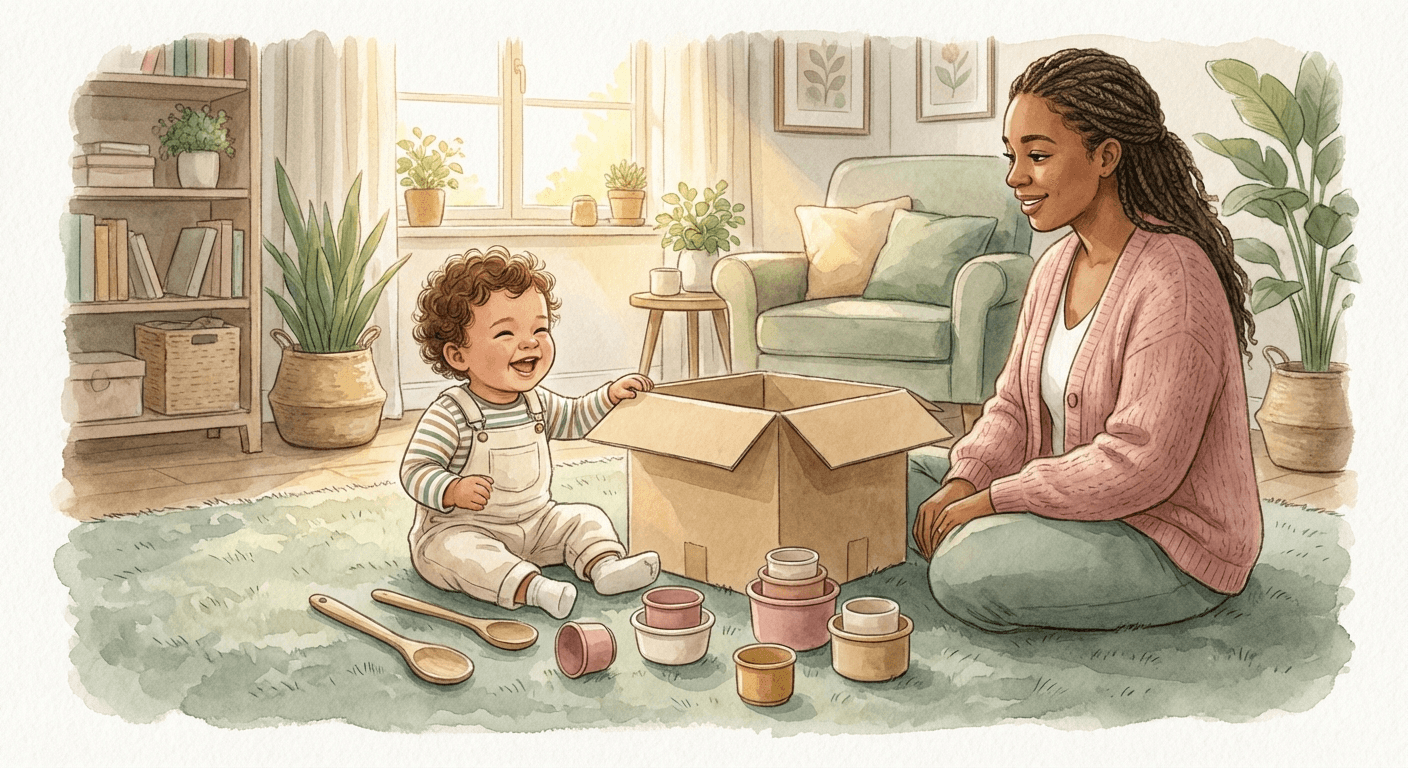
Your Baby Doesn't Need Expensive Toys to Develop Well — Here's What They Need Instead
The baby toy industry is worth billions — but research shows the best brain-building tools are free. Here's what science…
Boys' Brains vs. Girls' Brains: What Neuroscience Actually Tells Us
Are boys really "wired" for trucks and girls for dolls? The science of sex differences in baby brains is way more nuance…